Signs Your Interview Went Bad: How to Spot the Red Flags
Not sure how your interview went? Here are the key signs it may have taken a wrong turn and what they mean for you.
Overview
This blog explains how to recognize signs of a bad interview, from disengaged interviewers to vague feedback and delayed recruiter responses. It covers red flags in tech interviews, startup interviews, and remote settings. You also learn how AI tools evaluate your answers and how to turn a poor interview experience into growth through reflection, practice, and skill improvement.
You walk out of a job interview and replay every answer in your head. Did you say the right thing? Did they like you? Learning to read the signs your interview went bad helps you understand what happened, stop guessing, and prepare better for the next round. Most candidates feel uneasy after an interview, and the truth is that some of that worry is justified while a lot of it is not.
This guide walks through the clearest interview failure indicators, then flips the coin and shows you the signs interview went well looks like. You will also learn how long after interview to hear back, what to do after a bad interview, and how to turn one rough conversation into a stronger application next time.
Here is the honest part most articles skip: no single moment decides the outcome. A short answer, a glance at the clock, or a flat goodbye means little on its own. What matters is the pattern across the whole conversation. Read the signals in groups, weigh them against each other, and you will judge an interview far more accurately than by replaying one awkward second on a loop.
Why It Helps to Recognize the Signs Early
An interview runs both ways. The employer evaluates you, and you read the room at the same time. Spotting bad interview signs early gives you a head start instead of a surprise rejection email two weeks later.
- You reflect honestly and fix the weak spots before your next interview.
- You prepare emotionally instead of pinning everything on one result.
- You stop overanalyzing small moments that rarely change a hiring decision.
- You learn to manage setbacks, which every career involves at some point.
Reading these signals is not about blaming yourself. A recruiter who seemed cold may have had a rough morning. The goal is awareness, not self-criticism. When you know how to tell if an interview went bad, you also learn what a strong interview feels like, and that makes your next one sharper.
What Red Flags Do Recruiters Show When an Interview Fails?
Recruiters rarely say "this is not working" out loud. They send quieter signals instead. If the interviewer stops discussing next steps, avoids giving a timeline, or keeps answers short and generic, you are usually not moving forward. A hiring manager who has decided in your favor tends to talk about the future, not wrap things up quickly.
Another tell is when they skip the salary range, team structure, or company culture. Those topics come up when someone is selling you on the role. When the conversation stays flat and the recruiter offers no follow-up after a few days, that silence is often the answer. Below are the nine signals that show up most often.
9 Clear Signs Your Interview Went Bad
1. The Interview Ended Much Earlier Than Planned
A standard interview runs 30 to 60 minutes. If a scheduled 45 minute conversation wraps in 12, that short interview is a common interview failure indicator. It usually means the interviewer made up their mind early and saw no reason to dig deeper. A short interview is not always bad, but paired with low energy it rarely points your way. For example, if you prepared 40 minutes of material and the interviewer thanks you after eight, that mismatch is telling.
2. The Interviewer Stayed Disengaged
Watch the body language. If the hiring manager avoided eye contact, glanced at the clock, or rushed through questions, that is one of the strongest negative signals. An engaged interviewer leans in, follows up on your answers, and reacts to what you say. Flat delivery and one word reactions suggest your responses did not land. Picture an interviewer who answers your strongest story with a quiet "okay" and moves on; that lack of reaction is a quiet warning.
3. Few or No Questions About Your Skills
When an interviewer believes you might fit, they probe. They ask how you handled a tough project or what tools you used. If the recruiter barely touched your experience and skipped your achievements, they may have already filed you under no. Strong interviews are full of follow-up questions because the interviewer is building a case to hire you. If you mention leading a project and no one asks how, the interviewer may have stopped evaluating you for the role.
4. Closed-Off Body Language
Non-verbal cues carry weight. Crossed arms, repeated sighs, checking a phone, or a fixed neutral expression often signal low interest. One closed gesture means little, but a pattern of them across the conversation is worth noting. Compare it to a warm interviewer who nods, smiles, and mirrors your tone, which is the opposite signal.
5. No Discussion of Next Steps
This is one of the most reliable interview failure indicators. A promising interview ends with a roadmap: a second interview, a timeline, or a clear "we will email you Thursday." When the meeting closes with a vague "we will be in touch" and nothing concrete, the hiring manager may not plan to continue. The absence of a next round is louder than most candidates think. A strong close sounds like "our team will reach out by Wednesday," while a weak one trails off with no commitment at all.
6. Vague or Generic Answers to Your Questions
When you ask about the role, a genuinely interested interviewer gives detail. They explain the team, the projects, and the growth path. If your questions met short, dismissive replies, the interviewer likely was not picturing you in the seat. Effort flows toward candidates the company wants, so thin answers can mean low interest.
7. You Felt Rushed or Interrupted
If you never got space to finish a thought, or the interviewer cut you off repeatedly, that is a sign your interview went bad. It suggests they were not invested in hearing your full story. A relaxed pace, where you can explain context and the interviewer waits for you, usually points the other way. Being cut off twice in five minutes is a different experience from an interviewer who says "take your time, walk me through it."
8. The Focus Stayed on Problems, Not Possibilities
Some interviewers lean hard on how difficult the role is, how long the hours run, or how demanding the manager can be. Honest context is healthy, but a one sided focus on pain points sometimes works as a soft signal to steer you away. When no one mentions growth, learning, or why people stay, that imbalance matters.
9. The Interviewer Never Sold the Company
In strong interviews, employers pitch you too. They highlight culture, benefits, and why their team is a good place to build a career. If your interviewer skipped that entirely and treated the meeting as a formality, it can be a negative interview feedback sign that they did not see you as a likely hire.
Good Signs vs Bad Signs at a Glance
Sometimes it helps to see both sides next to each other. Use this table as a quick gut check after your next interview, then weigh the pattern rather than any single row.
| Signal | Interview went well | Interview went bad |
|---|---|---|
| Length | Ran the full time or longer | Ended well before the scheduled slot |
| Engagement | Leaned in, asked follow-ups | Distracted, checked the clock |
| Your skills | Probed your experience in depth | Skipped past your achievements |
| Language | Used "you would" about the role | Stayed neutral or noncommittal |
| Next steps | Gave a clear timeline | Offered a vague "we will be in touch" |
| The company | Sold you on culture and growth | Never pitched why you would join |
If most of your answers land in the right column, treat it as useful information rather than a final verdict. Hiring decisions involve more people and factors than one conversation reveals.
What Phrases and Body Language Hint at a Bad Interview?
Words and behavior shift in noticeable ways when an interview is not going well. Repeated lines like "we have many strong candidates" or "we will keep your resume on file" often soften a no. When the interviewer stops asking follow-up questions and no longer seems curious, engagement has dropped.
Body language fills in the rest. Minimal eye contact, a closed posture, quick transitions between questions, and a glance at the door all read as low interest. An abrupt ending with no talk of the team, the role, or the timeline is one more clue you can stack with the others. No single moment decides it, but several together paint a clear picture.
Signs You Did Not Get the Job After the Interview
Some signals appear after the interview rather than during it, and together they hint that an offer is unlikely. None of these guarantee a no, but a cluster of them is worth reading honestly so you can move your energy to the next opportunity.
- Total silence past the stated timeline. If the recruiter promised an update by Friday and two weeks pass with nothing, that gap is one of the clearer signs you did not get the job.
- A generic rejection template. Being rejected after interview with a one line "we moved forward with other candidates" and no detail usually means a quick screen out.
- The role gets reposted. Seeing the same job advertised again days later is one of the clearer signs you will not get the job offer from this round.
- Follow-ups go unanswered. When polite check ins get no reply at all, the company has likely moved on, even if no formal rejection arrives.
If you spot these, resist the urge to send a fourth message. Instead, ask for brief feedback once, thank them, and redirect your effort. A rejection is rarely about you as a person; it is one team weighing a specific mix of candidates on a specific day.
How to Know If an Interview Went Well
Reading the positive side matters just as much, because anxiety can make a good interview feel like a disaster. So how do you know if an interview went well? The signals are mostly the reverse of the red flags above.
- The interview ran longer than scheduled because the conversation kept flowing.
- The interviewer used future focused language like "you would handle" instead of "the person we hire."
- You met extra team members who were not on the original agenda.
- The hiring manager gave a specific timeline and encouraged you to ask more.
- The chat felt like a two way exchange, not an interrogation.
If you noticed several of these, the interview went well signs are stacking in your favor, and they are often early signs you got the job. For a deeper breakdown of positive signals, read our guide on the signs you will get the job after an interview, which maps out the signs you will get the job after interview and what recruiters do when an offer is coming. Even 6 signs the job interview went well, taken together, are a much stronger predictor than any single moment.
How Long After an Interview Should You Hear Back?
The wait is the hardest part, so it helps to know what is normal. Most companies respond within one to two weeks after a first interview, though it varies by role and team size. Once you know how long after an interview to hear back is normal, you stop reading early silence as a rejection.
- First interview: expect a reply in 5 to 10 business days for most roles.
- Final interview: how long after final interview to hear back is often a bit longer, since several stakeholders weigh in on the hiring decision.
- Large companies: internal approvals and applicant tracking system workflows can add a week or more.
If the interviewer gave you a date, wait until it passes before following up. When should you follow up after an interview? A polite follow-up email is reasonable a day or two after the stated timeline, not before. If you want exact wording, see our walkthrough on how to ask interview status through a message. Hearing nothing right away does not mean you were rejected after interview; it often just means the process is slow.
What to Do After a Bad Interview
Spotting several warning signs does not always end your chances, and how you respond still counts. Here is a practical plan instead of a spiral of worry.
- Send a thank-you note anyway. A short, specific thank-you email shows professionalism and can shift a borderline call in your favor.
- Do not assume the worst. Interviews often feel worse than they were. A distracted interviewer may simply have had a packed day.
- Reflect honestly. Note where you stumbled, which questions caught you off guard, and how you would answer them now.
- Ask for feedback. Learning how to ask for feedback after interview is a skill. A brief, gracious request sometimes earns useful pointers, even after a no.
- Keep applying. Never pin everything on one result. A full pipeline takes the pressure off any single interview.
One of the most useful moves is fixing the document that got you the interview in the first place. If you keep getting interviews but not offers, your resume may be underselling your impact. Run it through SoundCV to score your resume against the rules an applicant tracking system uses, then tighten the weak bullets before your next application. You can also start from a clean, recruiter friendly layout with the SoundCV resume templates so formatting never costs you a callback. A sharper resume often means stronger interviews, because you walk in backed by clearer proof.
Can AI Tools Evaluate Your Interview Answers?
Yes. Several tools run mock interviews and review your answers for structure, clarity, and relevance. Some go further and assess pacing, tone, and delivery on video so you can see how you come across before the real thing.
- Mock interview platforms score your answers to behavioral questions and situational prompts, then flag where your responses lacked detail.
- Coaching tools give real-time feedback as you practice, which helps you tighten rambling answers.
- Technical interview tools review your problem solving live, useful for coding or analytical roles.
Treat automated feedback as a rehearsal aid, not a verdict. Real interviews weigh interview rapport, nuance, and follow-up questions that no tool fully captures. Practice with them, then refine your answers around your own experience so you still sound like yourself. If you want a stronger base before practice, build a focused resume first with the SoundCV AI resume builder, then rehearse the stories behind each bullet.
Common Mistakes That Make an Interview Go Bad
Many rough interviews trace back to a handful of fixable mistakes. Knowing them helps you avoid the patterns that quietly sink candidates who are otherwise qualified.
- Rambling answers. Long, unfocused responses lose the interviewer fast. Use a simple structure: the situation, what you did, and the result with a number attached.
- No stories, only adjectives. Saying you are "hardworking" means little. Saying you "cut report turnaround from five days to two" proves it. Concrete examples beat labels every time.
- Weak questions at the end. Asking nothing, or only about salary, signals low interest. Prepare two or three questions about the team, the priorities, and how success is measured.
- A resume that oversells. If your resume promises skills your answers cannot back up, the gap shows. Align your stories with what your resume claims before you walk in.
- Visible nerves you never managed. Some anxiety is normal, but practice steadies it. A mock run with a friend or an AI tool smooths the delivery that interviewers actually notice.
Most of these are preparation problems, not talent problems. Tighten your stories, match them to a clean resume, and rehearse out loud, and you remove the most common reasons interviews go sideways.
How to Turn a Bad Interview Into Growth
A rough interview is data, not a dead end. Every difficult conversation shows you exactly what to drill before the next one. Maybe a behavioral question exposed a story you tell poorly, or a salary question caught you flat. Write those gaps down while they are fresh, ideally within an hour of leaving, because the specific questions fade fast once the adrenaline drops.
Then rehearse out loud. Reading answers in your head feels smooth, but speaking them reveals the gaps. Pair that with a tightened resume and clearer talking points, and your candidate evaluation improves on its own. Many people who felt sure they failed an interview went on to get the offer, because the recruiter was simply slow or weighing several strong candidates. Strengthen what you control, including your resume, your stories, and your follow-up, and let the rest play out. When you are ready for the next application, check your resume score and fix the flags before you apply.
For more interview prep, brush up with common interview questions and answers and sharpen how you introduce yourself with the right words to describe yourself in an interview. The candidates who recover fastest are the ones who treat each interview as practice for the next.
Keep one idea in front of you through the whole search: you control your preparation, your resume, and your follow-up, and very little else. You cannot control how many strong candidates applied, what budget shifts happened that week, or whether the interviewer was distracted. So pour your energy into the parts you own. Tighten your resume until it scores well, rehearse your three best stories until they are smooth, and send a clean follow-up every time. Do that consistently, and the bad interviews become rare while the good ones start turning into offers.
FAQs
Frequently asked questions about this topic
Related Blogs
Explore more insights and guides you might like.
Resignation Letter Format 2026: 10 Free Templates and Samples
The exact resignation letter format for 2026, plus ten free templates and samples you can copy in minutes.
JavaScript Interview Questions and Answers: Complete Guide for Developers
Learn resignation letter format with 7 free templates for different situations. Write professional, clear, and effective resignation letters easily.
Python Interview Questions and Answers (Complete Guide for Beginners & Experts)
Comprehensive Python interview questions and answers guide covering basics, advanced concepts, and expert tips to help you land your dream job.

Words to Describe Yourself: Best Examples for Resume & Interview
Learn powerful words to describe yourself for resumes and interviews with examples, tips, and strategies to stand out professionally
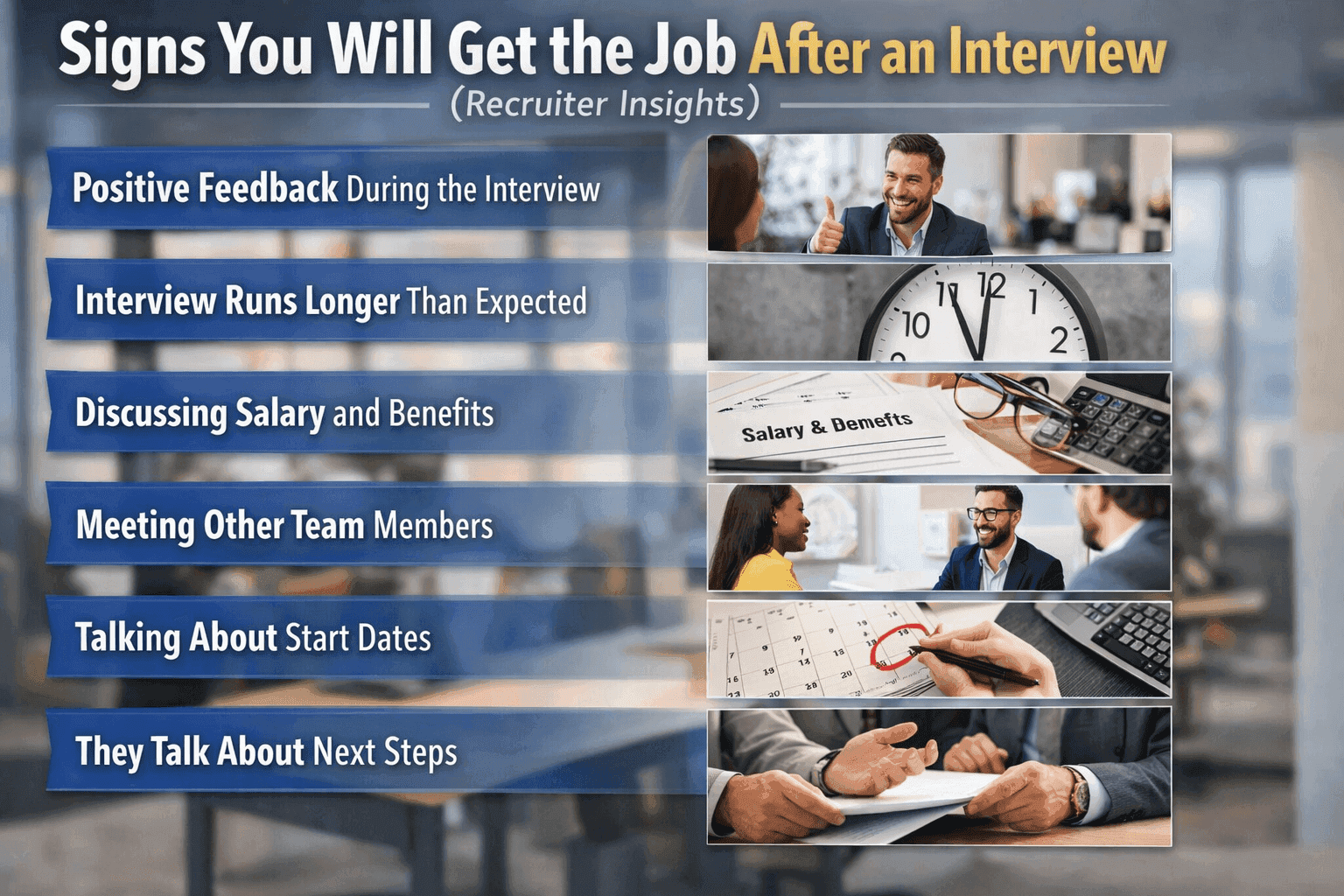
Signs You Will Get the Job After an Interview (Recruiter Insights)
Learn the most reliable signs you will get the job after an interview and how to understand recruiter signals.
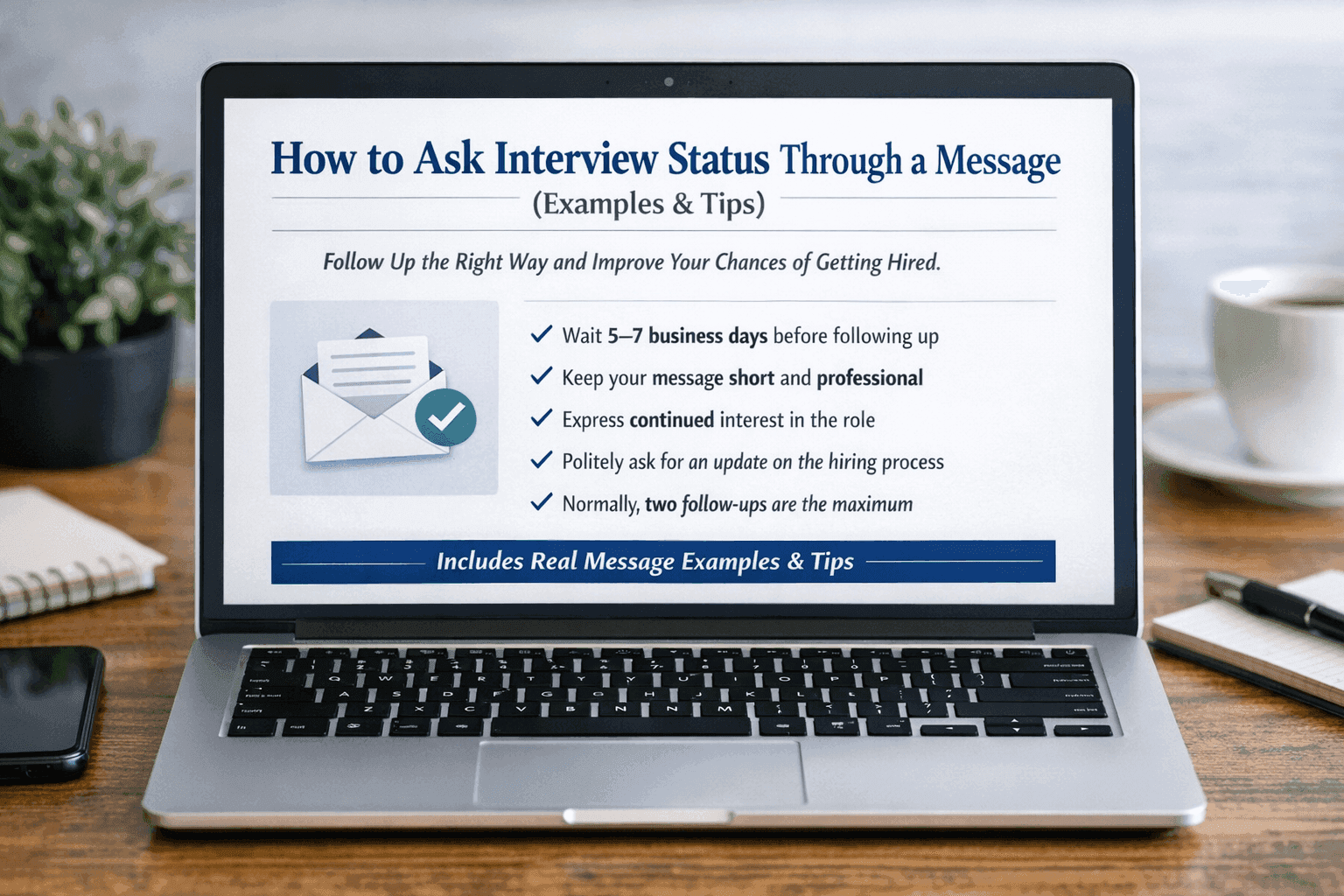
How to Ask Interview Status Through a Message (Examples & Tips)
Learn how to ask about interview status politely with professional follow-up messages, timing tips, and real examples to improve hiring chances.