Skills for Resume: Best Hard & Soft Skills (2026 Guide)
Showcase your strengths the right way discover the top hard and soft skills employers want in 2025.
Overview
Your resume’s skills section is one of the first things both recruiters and ATS systems check. This 2025 guide explains how to pick the right mix of hard and soft skills, show proficiency, and format them for maximum impact so your resume passes filters and grabs attention fast.
If you want your resume to land interviews, the skills for resume section can't be an afterthought. It is the second most-scanned area after Work Experience, and it is the first place both Applicant Tracking Systems (ATS) and human recruiters look for relevance. The right mix of hard skills and soft skills, formatted so a parser and a busy hiring manager both find what they need, can move you from the reject pile to the interview shortlist in seconds.
This 2026 guide shows you exactly what skills to put on a resume, how many to include, how to prove each one with numbers, and how to match your list to a specific job before you apply. You will get copy-ready examples of skills for resume by function, a categorized bank of 100 competencies, a before-and-after rewrite, and a fast way to find the gaps between your resume and the role you want. Whether you are writing your first resume, switching careers, or polishing a senior profile, the same principles apply: be specific, prove what you list, and match every skill to the job in front of you.
Why your skills section decides if you get the interview
Most companies screen applications with an ATS before a person ever reads them. The software ranks each resume against the job description, and your skills block is where it finds the strongest keyword matches. A 2024 Jobvite survey found that recruiters spend an average of 7 seconds on a first resume pass. In that window, a clear skills summary for resume tells them whether you fit the role.
Skills also anchor the rest of your resume. When you name a competency in your skills section and then prove it in a bullet point, the recruiter sees consistency. When you list a skill with no evidence anywhere else, it reads as filler. The goal is a tight set of skills and abilities for resume that you can back up with a result, a tool, or a measurable outcome.
Hard skills vs. soft skills for resume
Every competency you list falls into one of two buckets. Knowing the difference helps you balance the section so it reads as both technically credible and easy to work with.
Hard skills for resume are teachable, measurable abilities tied to tools, software, or methods. Examples include SQL, financial modeling, Adobe Photoshop, bilingual fluency, and GA4 reporting. You can prove them with a certificate, a portfolio, or a number. They are the keywords an ATS matches most directly, so they carry the heaviest weight in screening.
Soft skills for resume are behavioral traits that shape how you work with others, such as communication, problem-solving, adaptability, and leadership. They are harder to measure, so they only convince a recruiter when you show them in action. Instead of writing "great communicator," prove it: "Presented quarterly results to a 40-person leadership team and cut reporting questions by half."
A strong resume uses both. A useful starting ratio is roughly 60% hard skills and 40% soft skills, then adjust toward the job. A senior engineering role leans technical; a customer success role leans interpersonal. For a deeper breakdown, see our guide on hard skills vs soft skills.
What skills to put on a resume
The honest answer to what skills to put on a resume is: the ones the job description asks for, that you can prove. Start by reading the posting and circling every named tool, method, and trait. Those exact phrases are your shortlist. Then layer in complementary competencies that round out your profile without padding.
If you are wondering what skills should I put on my resume when the posting is vague, default to the high-value categories below. These are good skills to put on a resume across nearly every field, and they double as strong keyword targets.
- Core technical skills tied to your function (data analysis, accounting, UX design, project management software).
- Communication skills resume recruiters expect: writing, presenting, stakeholder updates, cross-team coordination.
- Problem-solving and analysis: root-cause analysis, A/B testing, forecasting, troubleshooting.
- Leadership skills resume signals: mentoring, project ownership, hiring, conflict resolution.
- Organization: time management, prioritization, documentation, process improvement.
People often ask what are good skills to put on a resume when they have nothing specific in mind, and the categories above answer that directly. If you are still asking what are some good skills to put on a resume for your field, choose the ones the posting names first, then add proven traits that support them. When you are unsure whether a competency belongs, ask one question: can I point to a moment where this skill produced a result? If yes, it earns a spot. If no, leave it off. That single filter separates the candidates who get interviews from the ones who list ten generic traits and prove none.
Good skills to put on a resume by job function
Generic lists help, but examples of skills for resume tied to real roles help more. Use the function closest to your target and trim to the eight to twelve that match the posting. These are good skills to put on a resume that recruiters in each field actively screen for.
Marketing: SEO, Google Analytics 4, content strategy, paid social, marketing automation (HubSpot), copywriting, conversion rate optimization, campaign reporting.
Software engineering: Python, JavaScript, REST APIs, Git, CI/CD pipelines, unit testing, system design, code review.
Sales: pipeline management, CRM (Salesforce), cold outreach, negotiation, forecasting, account expansion, discovery calls, quota attainment.
Finance and accounting: financial modeling, Excel (Power Query, Power Pivot), GAAP, forecasting, variance analysis, accounts payable, reconciliations, audit support.
Healthcare (nursing/CNA): patient assessment, EHR charting (Epic), medication administration, vital monitoring, infection control, care planning, patient education.
Teaching: lesson planning, classroom management, differentiated instruction, formative assessment, IEP support, parent communication, edtech tools.
These same examples make strong skills to put on a job application form, where space is tighter and you often get one line per skill. Lead with the hard skills the role names first, then add one or two soft skills you can defend in an interview.
Technical skills for resume and computer skills for resume
For most office and digital roles, your technical skills for resume do the heaviest lifting in ATS ranking because they are exact-match keywords. Group them by category so both the parser and the reader can scan quickly. A finance candidate might list "Tools: Excel, SAP, QuickBooks, Tableau" on one line and "Methods: forecasting, variance analysis, reconciliations" on the next.
Even non-technical roles benefit from a clear set of computer skills for resume. Recruiters assume baseline fluency, so only list software that signals depth: "Advanced Excel (Power Query)" beats a vague "Microsoft Office." If you are early in your career, our guide on how to add technical skills in resume walks through grouping and proficiency labels in detail, and our roundup of the technical skills employers want in 2026 shows which tools are trending up.
Soft skills for resume recruiters actually verify
Soft skills get a bad reputation because most candidates list them without proof. The fix is not to drop them, it is to demonstrate them. A recruiter cannot test "teamwork" from a word in a box, but they can believe it when they read "Coordinated a five-person cross-functional team to ship a product launch two weeks early."
The soft skills for resume that carry the most weight in 2026 are communication, adaptability, problem-solving, collaboration, and time management. For roles that touch clients or direct reports, add leadership skills resume signals and emotional intelligence. Whenever possible, move the proof into your experience bullets and keep the skills box for fast keyword matching. For phrasing ideas, see our examples of soft skills for a resume.
How to list skills on a resume for ATS and humans
Knowing how to list skills on a resume is half the battle. The format has to satisfy a parser that reads plain text and a recruiter who skims. Follow these rules and your skills section resume will pass both checks.
- Use a simple text list, not graphics. Skip skill bars, star ratings, and columns inside images. An ATS cannot read them, so the data is lost.
- Mirror the job ad's exact phrasing. If the posting says "GA4," write "GA4," not just "Google Analytics." Match singular and plural forms where natural.
- Group by category. Headers like "Technical," "Tools," and "Languages" help recruiters find what they need in two seconds.
- Repeat your top skills in the summary and experience. Keywords that appear in context rank higher and read as genuine, not stuffed.
- Lead with the most relevant. Put the skills the job names first in the list, since recruiters read left to right and top to bottom.
Before you submit, run your draft through a free ATS resume checker to confirm the parser reads your skills the way you intend.
How many key skills for resume should you include?
There is no single magic number, but ranges work better than guesses. List too few and you miss keyword matches; list too many and the section reads as padding with no proof behind it. Use these targets, then trim to what you can defend.
- Early career or career changers: 8 to 14 skills, weighted toward transferable and learnable abilities.
- Mid-career professionals: 12 to 18 skills, balanced across hard and soft.
- Executives: 8 to 12 core competencies, framed as leadership and strategy.
The right key skills for resume are the ones a recruiter can connect to your experience in under ten seconds. If you cannot tie a skill to a bullet, a result, or a tool you have used, it is taking up space a stronger keyword could fill.
Skills Gap Check: match your resume to the job before you apply
Every guide tells you to "tailor your skills to the job," then leaves the hard part to you. Here is how to actually do it. Paste the target job description and your current resume side by side, then mark every required skill the posting names. The skills present in the posting but missing from your resume are your gap, and closing it is the single fastest way to raise your match score.
SoundCV automates this loop. Drop your resume into the resume score checker with the job description, and it flags the exact skills and keywords the ATS is filtering for that your resume is missing. You get a score and a fix list instead of a guess. Add the genuine gaps, prove them in a bullet, and re-check. No competitor lets you close this loop on the page, and it is the difference between a resume that looks relevant and one that ranks as relevant.
AI skills for 2026 resumes
AI literacy moved from "nice to have" to a screened skill in 2026. Recruiters now look for candidates who can use AI tools responsibly inside their workflow, not just name-drop them. The credible way to list these is to pair the tool with the outcome: "Used ChatGPT and Claude to draft and QA marketing copy, cutting first-draft time by 40%."
Strong AI skills for resume in 2026 include prompt engineering, AI-assisted analysis, generative AI tools for your function, and AI governance or data-privacy awareness for regulated fields. Match the depth to your role, and never list a tool you cannot discuss in an interview. Our roundup of the top AI skills employers want on a resume breaks down which ones matter by industry.
Certifications as proof of your professional skills for resume
A certification turns a claimed skill into a verified one. When you list "Google Analytics" and back it with the Google Analytics Certification, a recruiter stops guessing about your level. This is one of the most underused ways to strengthen your professional skills for resume, especially for career changers who lack years of direct experience.
Place certifications in a dedicated section, and reference the most relevant ones next to the matching skill where space allows. Prioritize current, recognized credentials over expired or generic ones. For format and placement, see our guide on how to add certifications in a resume.
Special skills for resume and how to prove them with metrics
Some candidates have distinctive abilities that set them apart, such as a second language, public speaking, data storytelling, or community building. These special skills for resume are worth featuring, but only when they connect to the role or show range that matters to the employer.
The proof formula is the same for any skill: action plus tool plus result. "Built a personal finance newsletter to 5,000 subscribers using SEO and email automation" proves marketing range far better than listing "writing" and "marketing" in a box. Whenever you can attach a number, do it. Numbers make a skill believable and quotable, which is exactly what a recruiter wants to repeat to a hiring manager.
Skills to prune: outdated entries that hurt you
What you remove matters as much as what you add. Some entries make a 2026 resume look dated or unfocused. Cut "proficient in Microsoft Word," "hard worker," "team player" with no evidence, and any tool you have not touched in five years. These crowd out the keywords that actually rank and signal that you padded the section.
Replace them with current, specific competencies. Swap "internet research" for "competitive analysis," and "typing" for "documentation in Confluence." Every line should earn its place by either matching the job description or proving range the employer values.
The skills employers value most across every industry
While the exact list shifts by role, several competencies show up in nearly every 2026 job posting. LinkedIn's annual skills reports and the World Economic Forum's Future of Jobs research consistently rank analytical thinking, resilience, flexibility, and technology literacy at the top. These are the safe bets when a posting is light on specifics, because almost every hiring manager screens for them.
The pattern is clear: employers want people who can think through ambiguous problems, adapt when priorities change, and pick up new tools quickly. That last point matters most in 2026, as roles increasingly blend domain expertise with software fluency. A marketer who can read a dashboard, a nurse who can chart in Epic, and an accountant who can automate a report all signal the same thing: you can keep up as the work changes. When you choose key skills for resume, make sure at least a few of them speak to this adaptability.
How to quantify a skill so recruiters believe it
A skill with a number behind it beats ten skills listed in a box. Quantifying turns a claim into evidence, and evidence is what a recruiter repeats to the hiring manager. The formula is simple: action, plus the skill or tool, plus a measurable result.
Compare the two versions. Weak: "Strong project management skills." Strong: "Managed a $400K product launch across four teams and delivered two weeks ahead of schedule." The second version proves the skill, shows scope, and gives a number a recruiter can quote. Apply the same treatment to soft skills. Instead of "excellent communication," write "Wrote the onboarding documentation now used by 60 employees, cutting repeat questions by 35%."
Not every skill needs a metric, but your top three to five should. Pull numbers from anywhere credible: budget size, team size, time saved, percentage improved, revenue influenced, or volume handled. If you genuinely cannot find a number, describe the scope and outcome instead. The goal is to make every important skill on your resume defensible the moment a recruiter asks about it in an interview.
Transferable skills for career changers and little experience
If you are switching fields or writing your first resume, you may not have the exact hard skills a posting names. That is where transferable skills carry you. These are abilities that move with you across industries, such as project coordination, data analysis, customer communication, budgeting, and training others. They prove you can do the work even when your job titles do not match.
To use them well, translate each past experience into the language of your target role. A teacher moving into corporate training already has curriculum design, presentation, and assessment skills. A retail supervisor has scheduling, conflict resolution, and inventory management. Name the transferable skill, then prove it with a result: "Trained 12 new hires and cut onboarding time from three weeks to ten days." Recruiters hire for capability, not just history, and a clear set of skills and abilities for resume bridges the gap when your experience is thin or from another field.
Early-career candidates should also mine coursework, internships, volunteering, and side projects for evidence. A capstone project that used Python and Tableau is a legitimate technical skill, even without a paycheck attached. List it, then describe the outcome so it reads as practice, not theory.
Remote and hybrid work skills employers screen for in 2026
Distributed teams are now standard, and recruiters screen for the competencies that make remote work succeed. Async communication, self-management, and fluency with collaboration tools are no longer bonuses; they are expectations. If you have worked remotely, make those skills explicit rather than assuming the reader infers them.
The remote competencies worth listing include written communication, time-zone coordination, documentation discipline, and proficiency with tools like Slack, Notion, Zoom, and Asana. Pair each with a brief proof where you can: "Ran a fully remote 6-person team across three time zones using Asana and weekly async updates." These signals reassure a hiring manager that you can deliver without an office, which widens the roles you qualify for.
100 good skills to put on a resume by category
Use this categorized bank to find the right skills to put on resume for your field. Pick the eight to eighteen that match your target posting, then prove the important ones in your experience section. Treat it as a menu of good skills for resume, not a list to copy wholesale.
Communication and interpersonal: verbal communication, written communication, active listening, presentation, public speaking, negotiation, persuasion, conflict resolution, customer service, stakeholder management, cross-functional collaboration, relationship building.
Leadership and management: team leadership, mentoring, delegation, performance management, hiring, strategic planning, change management, decision-making, budgeting, project ownership, coaching, accountability.
Analytical and problem-solving: data analysis, critical thinking, root-cause analysis, forecasting, research, A/B testing, risk assessment, troubleshooting, process improvement, attention to detail, quantitative reasoning.
Technical and digital: SQL, Python, JavaScript, Excel (Power Query), Tableau, Power BI, Google Analytics 4, Salesforce, HubSpot, SAP, Git, REST APIs, cloud platforms (AWS, Azure), cybersecurity awareness, automation.
Organization and productivity: time management, prioritization, multitasking, documentation, scheduling, resource planning, quality assurance, deadline management, workflow design.
Creative and content: copywriting, content strategy, SEO, graphic design, video editing, UX design, storytelling, brand voice, social media management.
Notice how few of these are vague traits. The strongest examples of skills for resume name a tool, a method, or a measurable outcome. When you build your shortlist, favor the specific over the generic every time.
Where to place skills beyond the skills section
The dedicated skills block is only one of several places your competencies should appear. Spreading them across the resume gives the ATS more context and shows recruiters the skills in action rather than in isolation.
Put your top three to five skills in the resume summary so they appear in the first 100 words a recruiter reads. Weave the rest into your experience bullets, attached to results. Add a separate certifications section for any credential that validates a listed skill. If you are sending a cover letter, name the two or three skills the posting prioritizes and tie each to a quick story. This layering turns a flat skills summary for resume into a consistent thread that runs through the whole document.
Example: before and after skills section
Here is what tightening a skills block looks like in practice for a marketing candidate.
Before: "Microsoft Office, hard worker, good communication, team player, social media, marketing, detail-oriented, fast learner."
After:
Technical: SEO, GA4, HubSpot, Meta Ads Manager, Google Ads, A/B testing
Content: copywriting, editorial calendars, conversion copy
Strengths: stakeholder communication, campaign reporting, project ownership
The after version replaces vague traits with exact-match keywords, groups them for fast scanning, and keeps only the soft skills the candidate can prove in their experience bullets. That is the gap between a skills section that gets skimmed and one that gets you shortlisted.
Common mistakes to avoid in your skills section
- Listing skills you cannot prove. Every competency should map to a bullet, a tool, or a number somewhere on the page.
- Using graphics for proficiency. Skill bars and rating dots are invisible to an ATS, so the data never reaches the recruiter.
- Ignoring the job description. A generic list ranks poorly. Mirror the posting's exact phrasing for the skills you genuinely have.
- Padding with soft skills. Five unproven traits weaken the section. One proven trait strengthens it.
- Forgetting to update. Refresh your skills for every application; the same resume rarely fits two different postings.
Build a skills section that scores higher
Strong skills for resume are specific, provable, and matched to the job in front of you. Pick the eight to eighteen competencies the posting actually names, prove the important ones with numbers, format them in clean text for the ATS, and prune anything you cannot defend. Then verify the result before you hit send. Run your resume through SoundCV's free resume score checker to see which skills the ATS is filtering for, or start fresh with the AI resume builder and let it map your skills to the role automatically.
FAQs
Frequently asked questions about this topic
Related Blogs
Explore more insights and guides you might like.
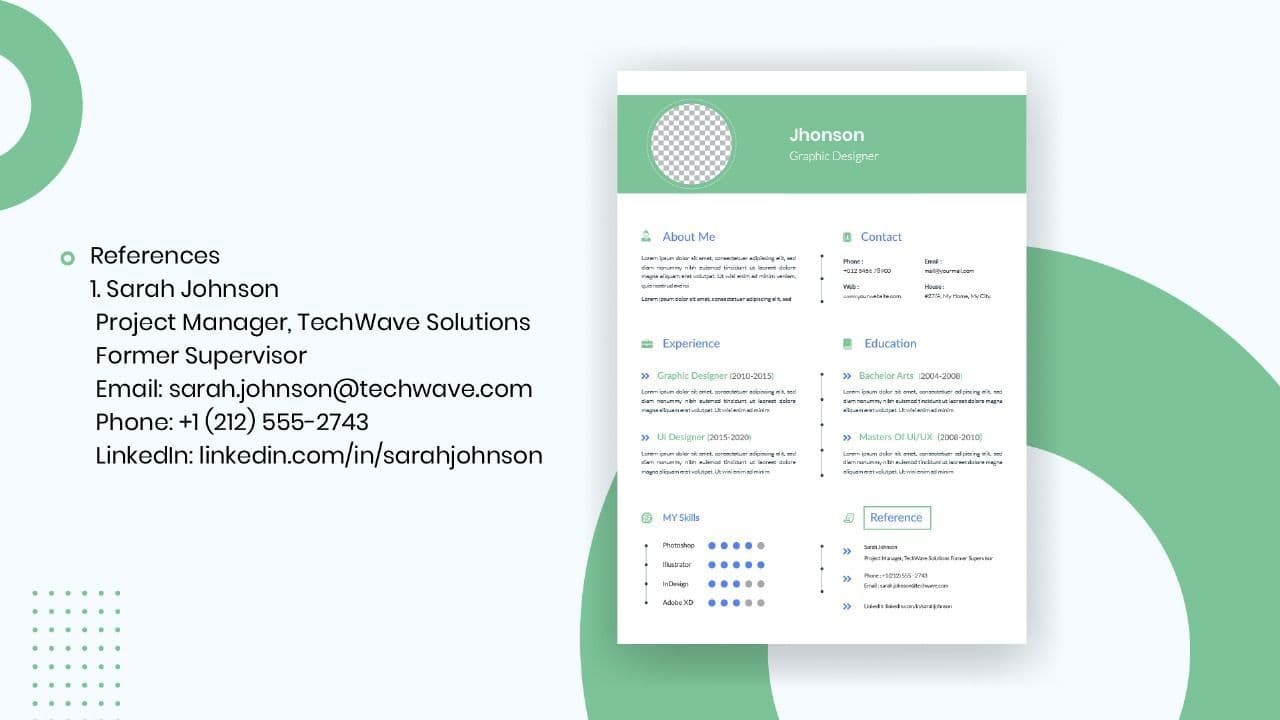
How to List References on a Resume in 2026
Learn the modern 2026 approach to listing references on your resume for maximum professionalism and recruiter impact.
Is Sound CV good for students and fresh graduates with no experience?
Sound CV is perfect for students and fresh graduates, helping them create professional resumes that highlight skills, projects, and potential even with little or no work experience.
Why Sound CV Is Different from Other AI Resume Builders
Sound CV stands out by creating job-focused, ATS-friendly resumes that highlight real achievements, not just generic content.
Resume Format for HR Job: Professional Guide and Sample Templates
A complete guide to the best resume format for HR jobs, with expert tips and sample templates to help you create a professional and job-ready resume.
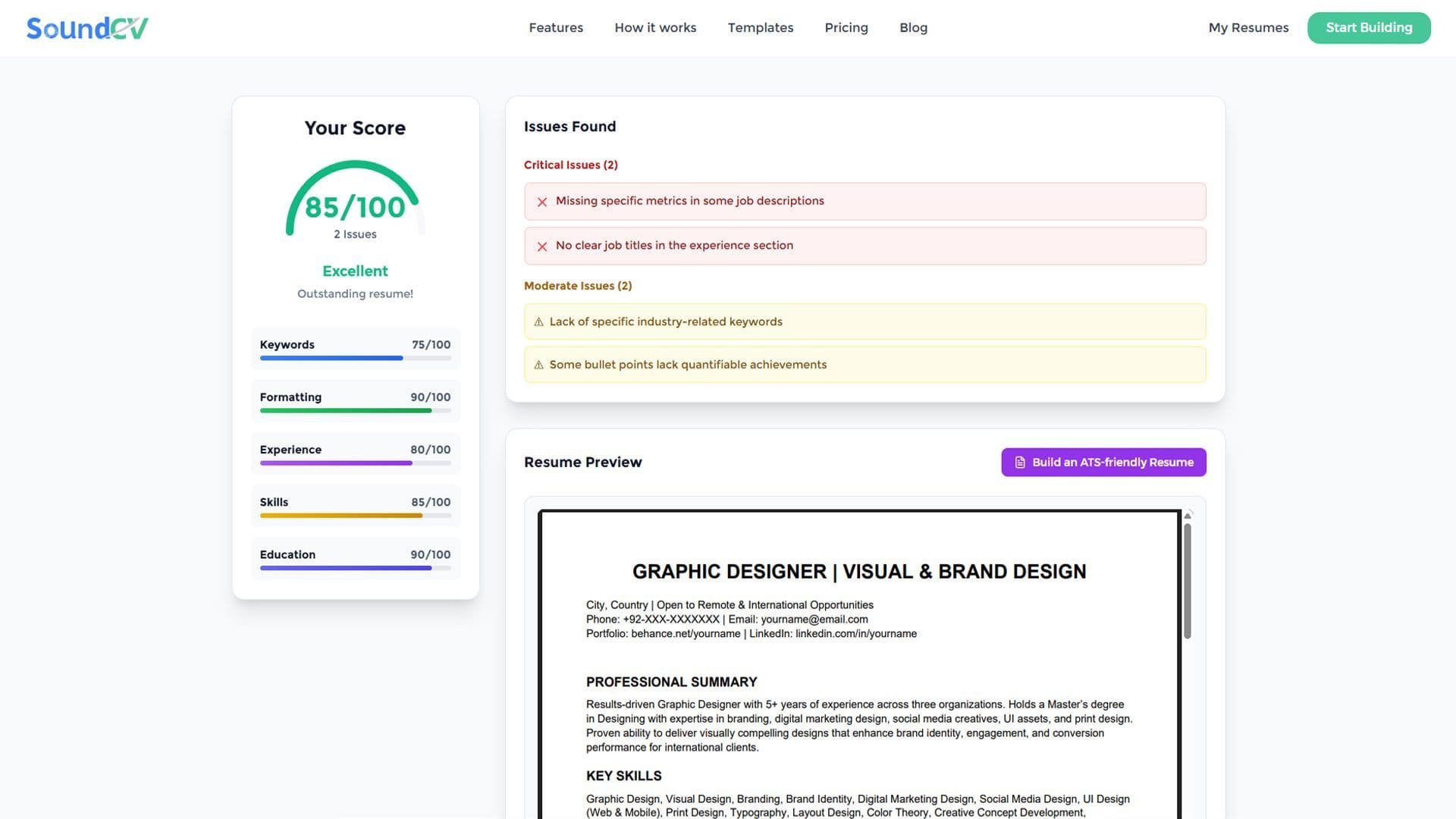
How Does the Sound CV Resume Score Checker Work?
The Sound CV Resume Score Checker analyzes your resume against ATS requirements, job-specific keywords, and structure to provide an instant, actionable score.

What Is a Sound CV? Features, Benefits, and How It Works
A Sound CV is an AI-powered resume that is tailored, ATS-optimized, and designed to showcase your skills and achievements to help you stand out to recruiters.