Resume Format for Engineering Students - Skills, Projects & ATS Tips
Learn how engineering students can build ATS-friendly resumes that highlight skills, projects, and education to secure more interviews.
Overview
This guide explains the best resume format for engineering students, focusing on ATS optimization, technical skills, projects, internships, and clean formatting to help freshers and graduates stand out in today’s competitive job market.
The right resume format for engineering students can be the difference between getting an interview call and getting filtered out before a recruiter ever sees your name. Many students have strong technical knowledge but still miss out because their resume is poorly structured or hides the skills that matter. Whether you are a fresher, a final-year student, or a recent graduate, the layout you choose decides how quickly a recruiter understands your value.
Recruiters spend only a few seconds on each resume. On top of that, most companies use Applicant Tracking Systems (ATS) to filter applications before a human reads them. If your engineering resume is not clear, well-organized, and keyword-aligned, your skills may never get noticed. This guide walks you through the best resume format for engineering students, the exact sections to include, branch-specific examples, and how to make every line work harder for you. If you have been searching for how to make resume for engineering students that actually gets shortlisted, or comparing every resume for engineering students template online, start here.
Why Resume Format Is Crucial for Engineering Students
Strong grades alone rarely secure a job. Recruiters look first at clarity and relevance, then at how well your skills are presented. A clean resume format for engineering students lets a hiring manager understand your background, technical strengths, and project work in seconds, not minutes.
Hiring managers scan rather than read. They look for education, technical skills, project experience, and certifications. If your resume is cluttered or visually inconsistent, important details get skipped. A logical structure keeps your education, skills, and projects easy to find at a glance.
Formatting also decides whether you pass the ATS. Engineering roles receive hundreds of applications, and the software filters resumes on structure, keyword usage, and readability before a recruiter sees them. A resume built with complex tables, columns, or graphics can be rejected automatically, even when the candidate is strong. A standard engineering resume format protects you from that silent rejection.
Also read: Most Effective Resume Format (2026): Ultimate Job Seeker Guide.
Best Resume Format for Engineering Students
There are three resume formats to choose from, and the right one depends on how much experience you have.
Chronological Resume Format
This format lists your education and experience in reverse-chronological order, newest first. It suits candidates with solid internship or work history, but it is not ideal for a fresher with limited experience, because the most space goes to the section you have the least to show.
Functional Resume Format
The functional format leads with skills instead of timeline. It can help career changers, but most recruiters and ATS parsers distrust it because it hides dates and context. Use it with caution as an engineering student.
Hybrid (Combination) Resume Format: Recommended
The hybrid resume format for engineering students is the most effective choice. It opens with a short summary and a skills snapshot, then backs it up with projects, education, and any experience in clear date order. You get the keyword visibility of a skills section and the credibility of a timeline. For nearly every engineering student and fresher, the hybrid layout wins, and it is the best resume format for engineers at the start of their careers.
Engineering Resume Format Template: Section by Section
Before the details, here is the section order that works for most students. Use this engineering resume template as your skeleton, then fill each block with your own content.
| Order | Section | Why it sits here |
|---|---|---|
| 1 | Header and contact | Recruiter needs to reach you instantly |
| 2 | Summary or objective | Sets your target role in two lines |
| 3 | Technical skills | ATS keyword match happens here |
| 4 | Projects | Proof of applied skill for freshers |
| 5 | Education | Degree, branch, and CGPA |
| 6 | Internships and training | Real-world credibility |
| 7 | Certifications and achievements | Extra signals of effort |
This engineering CV format keeps the parser happy and the recruiter oriented. Whether you build it in a word processor with an engineer CV template Word file, or use a structured online builder, keep the headings standard and the order predictable. A clean engineering student resume template beats a flashy one every time, and the same engineering CV template logic applies across every branch. The best engineering resume templates all share this predictable order, so when you browse engineering CV examples online, copy the structure rather than the colors. This CV format for engineering students works whether you call the file a resume or a CV.
Essential Sections in an Engineering Student Resume
Every section should earn its place. Here is what belongs in the top blocks of your resume.
Header Section
Keep it short and scannable. Include your full name, phone number, a professional email address, your LinkedIn URL, and a GitHub or portfolio link for technical roles. Skip your full street address and personal details like age or marital status, which add nothing and waste space.
Career Objective or Summary
For students, a two or three line objective works better than a long summary. Tailor it to the role and name a concrete strength.
Example: Motivated mechanical engineering student with hands-on CAD project experience and a 30% efficiency gain on a capstone design, seeking an entry-level role to apply simulation and prototyping skills.
Also read: Resume Format for College Students for a broader student template.
Education Section and GPA Strategy
Education is one of the most important blocks in any resume format for engineering students. Place it high on the page when you are a fresher, since it is your strongest credential. Include your degree name and branch, your university or college, your graduation year, and your CGPA when it is competitive.
GPA strategy trips up many students, so handle it deliberately. If your CGPA is 7.5 out of 10 (or roughly 3.2 on a 4.0 scale) or higher, list it. If it is lower, you have options. Lead with project impact and skills instead, show a strong major or final-year GPA if it beats your overall, or replace the number with relevant coursework that matches the job. Never invent a number, because most employers verify it.
Add relevant coursework only when it maps to the role. A computer engineering student applying for a backend job can list Data Structures, Operating Systems, and Databases. Listing every subject you took dilutes the signal.
You can also add one line for academic standing that supports your case, such as a department rank, a scholarship, or a strong final-year score. Keep dates clean and consistent, since mismatched formats confuse both recruiters and the ATS. If you studied abroad or hold an international degree, add the country and a one-line equivalence so a reviewer is not left guessing about your qualification level.
How to Showcase Technical Skills Effectively
Technical skills are the backbone of any engineering resume. Recruiters and ATS parsers both scan this block first, so make it precise. Choosing the right engineering skills for resume placement means matching the job description, not listing everything you have touched.
Skill Categorization
Group skills so they read fast. Common categories include:
- Programming languages (Python, C++, Java, MATLAB)
- Software and tools (AutoCAD, SolidWorks, MATLAB, Git)
- Hardware or core engineering concepts (PCB design, thermodynamics, structural analysis)
- Frameworks and platforms (React, Node.js, AWS, ANSYS)
Grouped skills improve both readability and ATS compatibility. Avoid skill stuffing, because a wall of 40 unrelated tools weakens your resume instead of strengthening it. Pick the 10 to 15 that match the role and prove each one elsewhere in your projects.
Also read: ATS-Friendly Resume Format for IT Engineers (2026).
Highlighting Projects, GitHub, and Portfolio
For engineering students with little formal work experience, projects are often the strongest section on the page. A good resume format for engineering students gives projects clear visibility and presents them as proof of applied skill, not as classroom exercises. Recruiters use this section to judge how well you turn theory into working solutions.
Write each project in a consistent shape: project title, the tools or technologies used, your specific role, and the measurable outcome. That shifts the focus from what the project was to what you actually built and achieved.
Example: Designed and built a smart irrigation system using IoT sensors and Arduino, cutting water usage by 30% across a test plot of 20 plants.
Not sure what counts as a project? More of your work qualifies than you think. Capstone and final-year projects, course assignments that produced something working, hackathon builds, open-source contributions, freelance work, and self-taught side projects all belong here. A second worked example shows the pattern for a software student:
Example: Built a full-stack expense tracker with React and Node.js, deployed on AWS, used by 40 classmates during a two-week pilot, reducing manual logging time by half.
Notice how both examples name the tools, your role, and a number. Two or three projects described this way outperform a list of six project titles with no detail. Choose the projects that match the job you want, and lead with the one most relevant to that role.
Link your work so recruiters can verify it. Add a GitHub URL for code, a personal portfolio for design or hardware projects, and a capstone report link where it helps. For software and computer engineering students especially, a clean GitHub profile with three or four well-documented repositories often carries more weight than a long list of skills. Place these links in the header and beside the relevant project, so a tech-forward hiring team can click through in seconds.
Also read: Google Resume Format: Craft a Resume That Gets Noticed.
Adding Internships, Training, and Certifications
Internships and industrial training add credibility, and even a short stint counts. A well-built engineering internship resume lists the company or organization, the duration, and two or three bullet points on what you did and learned. Quantify the outcome whenever you can, for example "automated a test report that saved the QA team four hours a week."
Certifications from recognized platforms belong here too, especially when they match your branch. A civil student might list an AutoCAD certification, a software student an AWS or Google Cloud badge. Quality matters more than quantity, so feature the certifications that map to the job you want.
Branch-Specific Engineering Resume Examples
Generic advice only takes you so far. Each engineering discipline values different keywords and tools, so tailor your resume to your branch. The examples below show what to emphasize, and each links to a deeper guide where one exists.
Software and Computer Engineering Resume
A software engineer resume should lead with languages, frameworks, and shipped projects. Recruiters scanning a software engineer resume template look for a stack summary, a GitHub link, and quantified outcomes near the top. When you study software engineer resume examples or a sample software engineer resume, notice how each bullet pairs a technology with a result. The same pattern drives a strong computer engineering resume and any software developer resume or software developer CV.
Match the layout to the exact role you target. A full stack developer resume highlights both front-end and back-end work, while a full stack developer CV adds deployment and database depth. A data engineer resume foregrounds pipelines and SQL, a machine learning engineer resume foregrounds models and metrics, and a DevOps engineer resume centers on CI/CD and cloud infrastructure. QA-focused students should study a QA engineer resume to see how test coverage and automation get framed.
| Target role | Lead with |
|---|---|
| Software developer resume / SWE resume template | Languages, projects, GitHub, one shipped feature |
| Full stack developer resume | Front-end + back-end stack, one end-to-end app |
| Data engineer resume | SQL, ETL pipelines, data volume handled |
| Machine learning engineer resume | Models trained, accuracy or F1 score, dataset size |
| DevOps engineer resume | CI/CD, Docker, cloud, deployment frequency |
| QA engineer resume | Test automation, coverage %, bugs caught |
If you are still deciding on a structure, review a clean software engineer CV template or a software engineer CV example, then borrow the section order rather than the styling. The best resume for software engineer roles maps your real projects to the job description, whether you draft it by hand, start from a software developer resume template, or use a dedicated resume builder for software engineer candidates. A good software engineer resume builder keeps your keywords aligned and avoids the formatting drift that breaks ATS parsing. Infrastructure-focused students can apply the same approach: a DevOps engineer resume sample shows how a strong DevOps resume frames automation and cloud work, and a clear DevOps resume example pairs each task with a deployment metric. Reviewing a few software developer resume examples side by side helps you refine your own bullets before you apply.
Mechanical Engineering Resume
A mechanical engineering student resume should foreground CAD tools, simulation software, and design or manufacturing projects. Recruiters reviewing a mechanical engineering resume template expect SolidWorks, AutoCAD, ANSYS, and a capstone or fabrication project with a measurable result. Students applying for plant, maintenance, or mechanic roles should mirror the exact job title from the posting, so a resume for mechanic or maintenance positions reads as a clean keyword match.
Also read: Best Resume Format for Mechanical Engineers.
Electrical Engineering Resume
Electrical students should highlight circuit design, PCB work, embedded systems, and lab tooling. When you study electrical resume examples, note how they pair a project (a power supply, a microcontroller build) with a concrete spec or efficiency number. List MATLAB, Multisim, and any embedded C experience near the top. If you are targeting power, control, or instrumentation roles, name the standards and equipment you have used, since recruiters in those fields screen for exact tool familiarity.
Other Branches: Chemical, ECE, and Aerospace
The same rules apply across every discipline. Chemical engineering students should lead with process simulation tools like Aspen, lab safety certifications, and a plant or reaction project with a yield figure. Electronics and communication (ECE) students should pair embedded and signal-processing skills with a working prototype. Aerospace students should foreground CAD, CFD, and any design or testing project with a measured result. Whatever your branch, the formula holds: name the tools, show one real project, and attach a number.
Civil Engineering Resume
A civil engineer resume should lead with site, structural, and drafting experience. Strong civil engineering resume examples show AutoCAD, STAAD Pro, and a real project such as a site survey or a structural design with a load or cost figure. Freshers can model their layout on a civil engineering resume template and keep the civil engineer resume format simple and ATS-safe.
Also read: Resume Format for Civil Engineer Fresher.
How to Write Strong Resume Bullets (Action Verb plus Result)
The bullets inside each section decide whether your resume reads as generic or sharp. Weak bullets describe duties; strong bullets describe results. Use a simple formula: action verb, what you did with which tool, and the measurable outcome.
- Weak: Responsible for a database project.
- Strong: Built a normalized MySQL database for a college event app, cutting query time by 40%.
- Weak: Worked on a robotics team.
- Strong: Programmed the navigation module in C++ for a line-following robot that placed second among 30 teams.
Start every bullet with a verb like built, designed, automated, tested, reduced, or led. Avoid filler openers like "responsible for" or "worked on." When you cannot attach a number, attach a concrete detail instead, such as the team size, the tool version, or the problem you solved. Three precise bullets beat eight vague ones, and they give the ATS the exact keywords it scans for.
Including Soft Skills and Achievements
Engineering work needs communication, teamwork, and adaptability, so include a short soft-skills line without overdoing it. List problem-solving, team collaboration, and time management, then prove them through your projects rather than just claiming them.
Give achievements their own block. Hackathon wins, technical competition placements, paper publications, and academic awards all signal initiative. One line each, with the result, is enough.
Resume Formatting Tips for Engineering Students
Good formatting raises readability and signals professionalism. Follow these rules:
- Keep the resume to one page (two pages only if you have real experience to fill it)
- Use professional fonts like Calibri, Arial, or Times New Roman at 10 to 12 point
- Maintain consistent spacing, alignment, and bullet style throughout
- Use bullet points instead of long paragraphs, and start each bullet with an action verb
- Export as PDF unless the employer asks for a Word file
A clean layout helps recruiters scan quickly and helps the ATS parse every line. Avoid common mistakes too: generic objectives, heavy design or color blocks, spelling errors, non-standard section headings, and ignored ATS rules all cause silent rejections, even for strong candidates.
ATS Optimization Tips for Engineering Resumes
ATS optimization decides whether a human ever sees your resume. To build an ATS resume for engineers that passes the filter:
- Use standard section headings (Education, Skills, Projects, Experience)
- Mirror keywords from the job description, including the exact tool and language names
- Avoid tables, text boxes, columns, and graphics in the final export
- Save as a simple PDF or Word file, named with your role and your name
- Spell out acronyms once, for example "Computer-Aided Design (CAD)"
Here is how keyword mirroring works in practice. Suppose a posting asks for "Python, SQL, and data visualization." A passing resume uses those exact phrases in the skills block and again inside a project bullet, for example "Built a sales dashboard in Python with SQL queries and Matplotlib visualizations." A failing resume writes "coding, databases, and charts," which a human understands but the parser scores as a miss. The closer your wording matches the posting, the higher you rank inside the ATS shortlist.
Want to know your score before you apply? Run your draft through SoundCV's free ATS resume checker to see exactly which rules you are passing and which keywords you are missing. It returns a score and a fix list in under a minute, so you can correct issues before a recruiter ever opens the file.
Resume Summary Examples for Engineering Students
A sharp summary tells the recruiter who you are in two lines. The right resume summary for engineering students names your branch, one standout skill, and one result. Use the B Tech resume format convention of leading with your degree when you are a fresher.
- Computer science: Final-year computer engineering student skilled in Python and React, with three deployed web projects and a hackathon runner-up finish.
- Mechanical: Mechanical engineering student fluent in SolidWorks and ANSYS, who cut a capstone assembly's part count by 18%.
- Civil: Civil engineering graduate with AutoCAD and STAAD Pro experience and a surveyed site project delivered two weeks early.
Also read: Resume Summary for Freshers for more ready-to-edit examples.
How Your Engineering Resume Evolves After Graduation
Your student resume is the first version, not the final one. Knowing where it heads helps you build the right foundation now. As you gain experience, projects move below work history, and the summary replaces the objective.
- Junior student: education and coursework lead, projects fill the gap for missing experience.
- Post-internship student: internship moves up, with quantified bullets taking center stage.
- Fresh graduate: a hybrid resume balances projects, internship, and skills.
- Two to five years in: work history leads; a senior software engineer resume or an engineering manager resume drops projects and foregrounds impact, scope, and team size.
Building good habits now, like quantifying every bullet and matching keywords to the role, means each future version is an edit rather than a rewrite.
Why Skills-Focused Resumes Work Better for Engineering Students
Engineering students rarely have years of experience, so a skills-and-projects layout plays to your strengths. It puts your strongest evidence first and gives the ATS the keyword density it needs. A timeline-only resume forces a fresher to display empty space where senior candidates show a decade of roles. The hybrid structure sidesteps that problem and reads as confident rather than thin.
How Engineering Students Can Continuously Improve Their Resume
Treat your resume as a living document. Update it after every project, internship, or certification while the details are fresh. Tailor a copy to each application by mirroring the job description's keywords, since one master resume rarely fits every role. Ask a mentor or senior to review it, and run it through an ATS checker before each submission.
You can also speed up the first draft. SoundCV's AI resume builder fills in your resume sections based on your job history and target role, so you start from a structured draft instead of a blank page, then refine the bullets yourself.
Should Engineering Students Add a Cover Letter?
A short cover letter still helps, especially for internships and roles that ask for one. Use it to explain why this company and this role fit your skills, and to point to the one project that proves it. Keep it to three short paragraphs: why you are writing, what you bring, and a clear close. Mirror a few keywords from the posting so the letter and resume tell the same story. When an application makes the cover letter optional, send one anyway for roles you care about, since it costs you ten minutes and gives a recruiter a reason to read your resume more closely.
Conclusion
The best resume format for engineering students is the hybrid layout: a short summary, a focused skills block, project proof, and a clean education section, all built to pass the ATS. Tailor it to your branch, quantify every bullet, link your GitHub or portfolio, and keep it to one clean page. Do that, and your resume will reflect the engineer you already are.
Ready to test it? Check your resume score free and get a fix list before you hit apply.
FAQs
Frequently asked questions about this topic
Related Blogs
Explore more insights and guides you might like.
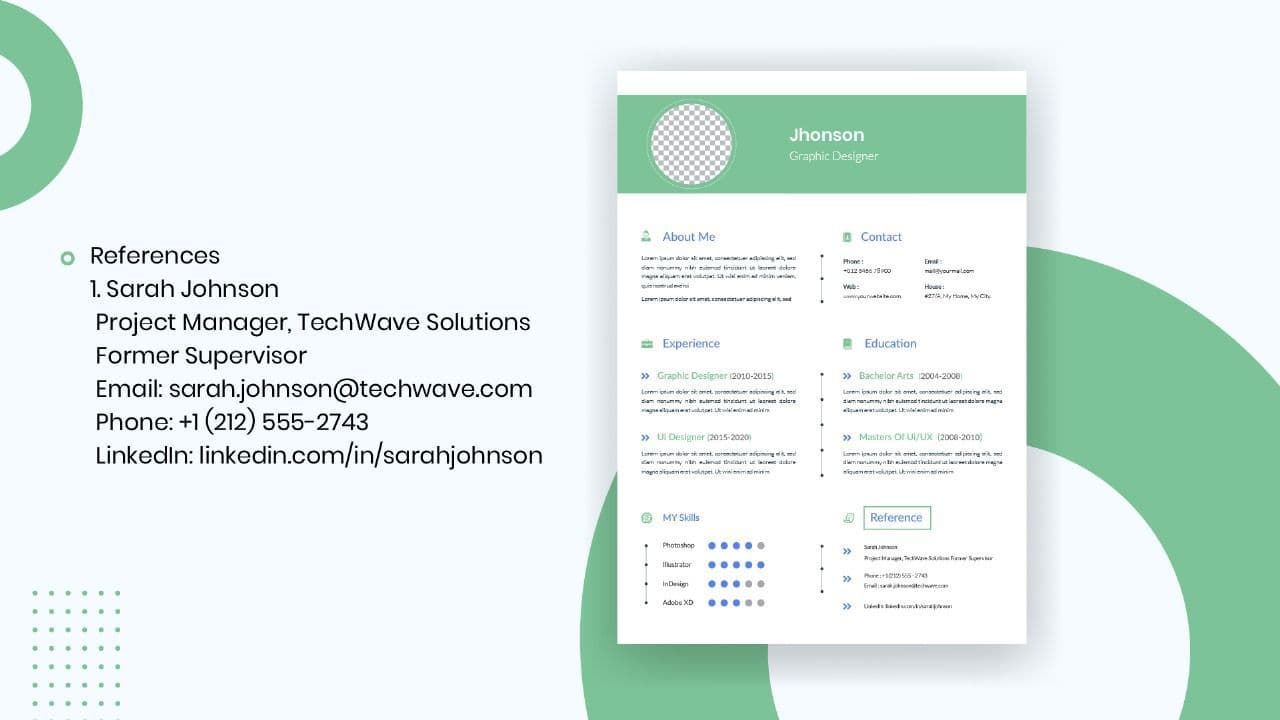
How to List References on a Resume in 2026
Learn the modern 2026 approach to listing references on your resume for maximum professionalism and recruiter impact.
Is Sound CV good for students and fresh graduates with no experience?
Sound CV is perfect for students and fresh graduates, helping them create professional resumes that highlight skills, projects, and potential even with little or no work experience.
Why Sound CV Is Different from Other AI Resume Builders
Sound CV stands out by creating job-focused, ATS-friendly resumes that highlight real achievements, not just generic content.
Resume Format for HR Job: Professional Guide and Sample Templates
A complete guide to the best resume format for HR jobs, with expert tips and sample templates to help you create a professional and job-ready resume.
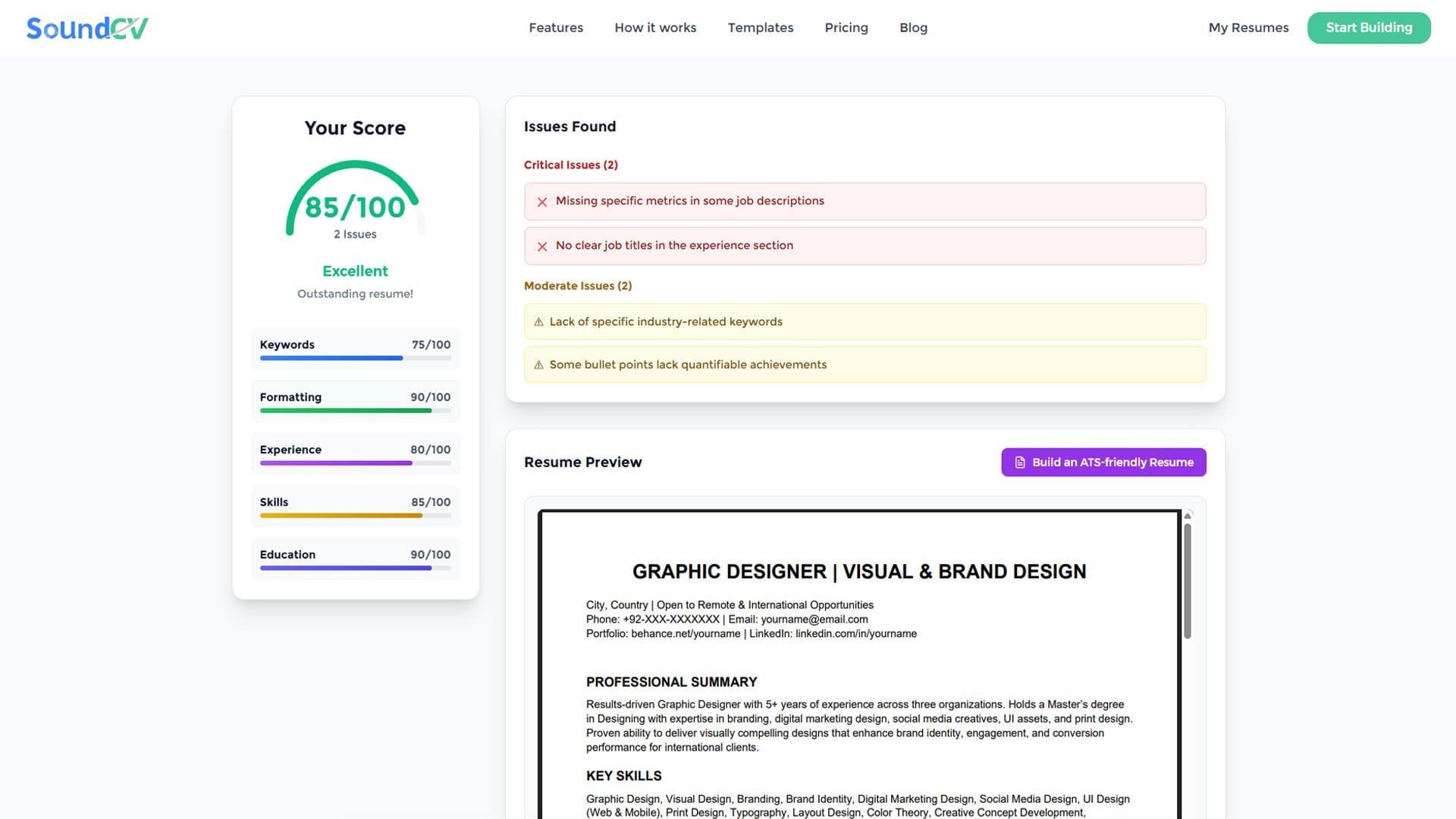
How Does the Sound CV Resume Score Checker Work?
The Sound CV Resume Score Checker analyzes your resume against ATS requirements, job-specific keywords, and structure to provide an instant, actionable score.

What Is a Sound CV? Features, Benefits, and How It Works
A Sound CV is an AI-powered resume that is tailored, ATS-optimized, and designed to showcase your skills and achievements to help you stand out to recruiters.