Resume Format for HR Job: Professional Guide and Sample Templates
A complete guide to the best resume format for HR jobs, with expert tips and sample templates to help you create a professional and job-ready resume.
Overview
This guide explains the best resume format for HR job applications, covering structure, recruiter expectations, ATS tips, and sample layouts for freshers and experienced professionals. It outlines key HR skills, formatting best practices, and common mistakes to avoid. Learn how to create a clear, professional, and job-ready HR resume that improves shortlisting chances.
Human Resources professionals shape company culture, manage talent, and keep organizations compliant. Because HR teams hire and screen everyone else, recruiters judge an HR resume more harshly than most. The right resume format for HR job applications signals clarity, structure, and judgment before a single bullet point is read. Whether you are a fresher entering the field or an experienced HR manager aiming for a senior role, the format you choose decides whether your application gets a closer look or a quick pass.
This guide breaks down exactly what recruiters expect, how to structure each section, which skills to highlight, and how to pass applicant tracking software. You also get two full resume samples, role-by-role examples, and a pre-submit checklist you can apply in minutes.
One note on wording: a human resources resume and an HR resume are the same document, so use whichever phrasing matches the job title. Throughout this guide you will find HR resume examples, a human resources resume template structure, and a sample human resources resume for both freshers and senior roles. If you prefer the term HR CV or human resources CV, the same rules apply; only the file name changes.
Why HR Resumes Need a Professional Format
HR professionals manage people, processes, and workplace culture. Their work covers hiring, onboarding, employee engagement, performance management, compliance, and conflict resolution. Recruiters expect that range to show up in a clean, organized document.
Because HR staff handle sensitive information and make decisions about other people, your resume is read as a sample of your judgment. A cluttered layout, inconsistent spacing, or a vague summary suggests weak attention to detail. In most roles that is a minor flaw. In HR it is a credibility problem.
Unlike design or creative jobs, HR resumes reward restraint. Skip the heavy colors, photos, icons, and multi-column layouts. A professional resume format for HR job applications keeps skills, experience, and qualifications in a logical order so a recruiter can assess fit in under ten seconds.
Clear section headings, consistent formatting, and tight bullet points show respect for process. Since HR professionals often screen resumes themselves, hiring managers read your resume as a preview of how you would evaluate others. Format and structure are not cosmetic here. They are part of the qualification.
What Recruiters Look for in an HR Resume
Recruiters scan an HR resume for a balance of people skills, process knowledge, and accuracy. They want proof that you can communicate clearly, act ethically, and handle confidential data without slipping.
Strong communication sits at the top of the list. HR roles involve constant contact with employees, managers, and leadership, so your bullets should show you can explain policy and resolve issues. Knowledge of core HR processes and labor law comes next, because it signals you understand compliance and best practice.
Recruiters also look for exposure to the recruitment lifecycle and employee management: hiring coordination, onboarding support, performance reviews, or engagement programs. Even an internship or campus project counts when it shows real involvement. The strongest hr resume skills are the ones backed by a measurable outcome rather than a job duty.
Finally, recruiters reward organization. HR work means maintaining records, running reports, and keeping data accurate across systems. A resume that is well-structured and error-free demonstrates those traits without you having to claim them.
Read our other industry resume guides:
Best Resume Format for HR Jobs
The most reliable hr resume format is reverse-chronological or hybrid. Both keep your career timeline clear while making your most relevant HR work easy to find.
Reverse-Chronological Format
- Best for experienced HR professionals with a steady work history
- Lists your most recent role first, then works backward
- Shows career growth and promotions at a glance
- Preferred by recruiters and parsed cleanly by applicant tracking systems
Hybrid Format
- Ideal for HR freshers, career switchers, and anyone with gaps
- Leads with a skills summary, then supports it with experience
- Emphasizes capability when your timeline is short or non-linear
Keep length tight. Use one page for HR freshers and one to two pages for experienced professionals. A functional, skills-only format is rarely a good idea for HR because recruiters read missing dates as a red flag. Avoid creative designs and color blocks. Clarity beats decoration every time.
Ideal Resume Structure for HR Professionals
Use the same section order whether you build from scratch or start from an hr resume template. A predictable structure helps both the recruiter and the parser.
Resume Header
Keep the header simple and professional. Include your full name, phone number, professional email, city and country, and a LinkedIn URL. Recruiters will look you up anyway, so make your LinkedIn match your resume. Leave out age, marital status, and photos unless a specific market requires them.
Career Objective or Professional Summary
This opening section changes with your experience level, and it is the first thing a recruiter reads. Make it count in two or three lines.
Career Objective for HR Freshers
A short statement showing your interest in HR and your readiness to learn. Keep it specific to the role.
Motivated HR graduate seeking an entry-level HR role to apply strong communication skills, knowledge of recruitment and onboarding, and hands-on internship experience to support a growing people team.
Professional Summary for Experienced HR Professionals
A tight overview of your specialization and your biggest wins. A good hr resume objective or summary names a focus area and one quantified result.
HR generalist with 6 years across recruitment, employee relations, and HRIS administration. Cut average time-to-fill from 42 to 28 days and lifted engagement survey scores by 19% across a 300-person organization.
That second example works because it states a specialization and a measurable outcome. A strong human resources resume summary always pairs a focus with a number.
Core HR Skills Section
This section anchors the whole document. Split it into functional skills and tools so the parser and the recruiter both find what they need.
Functional HR skills:
- Recruitment and talent acquisition
- Employee onboarding and engagement
- Performance management and appraisals
- Payroll and HR operations
- Employee relations and conflict resolution
- Labor law and compliance basics
HR tools and software:
- HRIS and HRMS platforms (Workday, SAP SuccessFactors, BambooHR)
- Applicant tracking systems
- Payroll software
- MS Excel and reporting dashboards
List only skills you can defend in an interview. Padding this section is the fastest way to lose trust.
Work Experience
For experienced candidates, this is the most important section. For each role, list your job title, company name, dates, and a short list of responsibilities and achievements. Lead every bullet with an action verb and attach a result wherever you can.
Focus on impact, not routine. "Managed onboarding" tells a recruiter nothing. "Redesigned onboarding and cut new-hire 90-day turnover by 18%" tells them you drive outcomes. Aim to put a metric on at least half of your bullets.
Education and Certifications
List your degree, specialization, institution, and graduation year. Relevant certifications add real weight to an HR application:
- SHRM-CP or SHRM-SCP
- CIPD (UK and international)
- PHR or SPHR
- HR analytics or labor law short courses
Freshers should place education above experience. Experienced professionals should keep it near the bottom.
HR Projects and Internships
For freshers, internships and academic projects prove practical exposure. Strong examples include campus recruitment drives, an HR operations internship, or an employee engagement initiative. Describe the responsibility and the learning outcome in one or two lines each.
Soft Skills and Professional Traits
HR runs on interpersonal ability. Highlight communication, empathy, conflict resolution, confidentiality, and problem-solving. Keep the list short and real rather than a wall of adjectives.
Essential HR Resume Skills to Include
Recruiters and ATS software both scan for specific terms, so your hr resume skills section should mirror the language of the job description. Pull the exact phrases from the posting and weave them in where they are true for you. When a recruiter reviews a human resources skills resume, they want hard competencies backed by proof, not a generic list.
Hard skills that signal HR competence include talent acquisition, employee relations, compensation and benefits, performance management, workforce planning, HR compliance, payroll processing, and HRIS administration. Pair these with measurable proof. "Employee relations" means more when it reads "resolved 40+ employee relations cases with zero escalations to legal."
Soft skills still matter, but anchor them to outcomes. Instead of "great communicator," write "ran monthly all-hands updates for 250 staff and cut policy-related queries by 30%." That turns a generic claim into evidence a recruiter can trust.
How to Quantify Achievements on an HR Resume
Numbers are what separate a forgettable HR resume from a shortlisted one. Most candidates describe duties; strong candidates describe results. The fix is to attach a metric to every meaningful bullet.
Use these HR metrics to quantify your impact:
- Time-to-fill: "Reduced average time-to-fill from 45 to 30 days across 60 annual hires."
- Retention and turnover: "Lifted first-year retention from 72% to 88% through a revamped onboarding program."
- Engagement scores: "Raised employee engagement survey results by 21 points in 12 months."
- Cost savings: "Renegotiated a benefits contract and saved $120K annually."
- Volume and scale: "Managed payroll for 500 employees across 3 locations with 100% accuracy."
If you do not have exact figures, estimate honestly with ranges or percentages. A defensible estimate beats a vague claim, and it gives the interviewer something concrete to ask about.
How Long Should an HR Resume Be
Length depends on your experience, not on how much you can write. Recruiters spend seconds on the first pass, so every line has to earn its place.
Stick to one page if you have fewer than seven years of HR experience or you are a fresher. A single, focused page reads as confidence and discipline. Move to two pages only when you have senior or specialized experience that genuinely needs the room, such as multi-site HR leadership or a long list of relevant certifications. Never pad a resume to fill space, and never shrink fonts below 10.5 to cram two pages into one. If you are cutting, drop old roles, generic duties, and anything older than ten to twelve years that no longer supports your target job.
Action Verbs That Strengthen an HR Resume
Strong verbs make your bullets read like results rather than a job description. Open each bullet with a verb that shows ownership, then follow it with a number.
Useful HR action verbs include recruited, sourced, onboarded, streamlined, negotiated, resolved, implemented, coached, audited, and reduced. Compare "responsible for recruitment" with "recruited 45 candidates across engineering and sales in 9 months." The second version shows scope and outcome in the same breath. Avoid passive phrases like "was tasked with" or "helped with," which hide your actual contribution. A resume built on active verbs and metrics gives a recruiter a fast, clear read of what you can do.
ATS-Friendly Resume Tips for HR Roles
Most companies, including the HR teams you are applying to, use an applicant tracking system to filter resumes before a human reads them. An ATS-friendly resume format for HR job roles gets you past that first screen.
- Use standard section headings like "Work Experience," "Skills," and "Education"
- Avoid images, charts, text boxes, and symbols the parser cannot read
- Keep a single-column layout with no tables for core content
- Save and submit as PDF or DOCX, matching whatever the posting requests
- Mirror the keywords from the job description naturally in context
Build a short HR keyword bank before you write. Common ATS terms for HR roles include talent acquisition, employee engagement, performance management, HRIS, payroll, onboarding, compliance, employee relations, and workforce planning. Place each term where it genuinely applies rather than stuffing a list. If you want a fast check on coverage, run your draft through SoundCV's free ATS resume score checker to see which keywords you are missing before you apply.
Resume Formatting Tips for HR Jobs
Clean formatting improves both readability and ATS compatibility. Stick to a few rules and your resume will look polished without fuss.
- Fonts: Calibri, Arial, or Times New Roman
- Font size: 10.5 to 12 for body text, slightly larger for headings
- Use bullet points rather than dense paragraphs
- Keep spacing and alignment consistent across every section
- Use bold sparingly to draw the eye to titles and metrics
Skip graphics, icons, and decorative tables unless you are applying for a non-traditional or creative HR role. White space is your friend; a crowded page tires the reader and hides your best bullets.
Common Resume Mistakes to Avoid in HR Resumes
A few recurring errors sink otherwise strong HR applications. Watch for these before you submit:
- Generic career objectives that could fit any role or industry
- Listing duties instead of results, with no numbers anywhere
- Spelling and grammar slips, which read as carelessness in an HR candidate
- Overstuffed skills sections full of terms you cannot back up
- Inconsistent date formats, fonts, or bullet styles
- Including a photo, age, or marital status in markets that discourage it
Proofread obsessively. You are applying for a role that screens other people's resumes, so a typo on yours raises an obvious question about your standards.
Sample Resume Format for HR Fresher
This hr resume sample shows how a fresher with limited experience can still present a focused, credible application using the hybrid format.
Riya Sharma
Mumbai, India | riya.sharma@email.com | +91 90000 00000 | linkedin.com/in/riyasharmaCareer Objective
Motivated MBA-HR graduate seeking an entry-level HR role to apply recruitment, onboarding, and engagement skills gained through two internships supporting a 150-person team.Core Skills
Recruitment support | Onboarding coordination | Employee engagement | HRIS data entry | MS Excel | CommunicationInternships
HR Intern, TechNova Solutions (6 months)
- Screened 200+ applications and scheduled 60 interviews, cutting recruiter coordination time by 25%
- Coordinated onboarding for 18 new hires with a 100% document-completion rate
- Supported a campus engagement survey that reached 90% participation
Education
MBA, Human Resources, University of Mumbai, 2025Certifications
SHRM Essentials of HR | LinkedIn Learning: HR Foundations
This entry level hr resume works because it leads with skills, then proves them with quantified internship bullets. Even without full-time experience, the numbers give a recruiter something concrete. The same approach applies to any entry level human resources resume: lead with capability, then back it with proof.
Sample Resume Format for Experienced HR Professional
This hr resume sample uses the reverse-chronological format that suits a mid-career candidate targeting an HR manager position.
Arjun Mehta
Bengaluru, India | arjun.mehta@email.com | +91 98000 00000 | linkedin.com/in/arjunmehtaProfessional Summary
HR generalist with 7 years across talent acquisition, employee relations, and HR operations. Cut time-to-fill by 35% and managed payroll and compliance for a 400-employee organization.Core Skills
Talent acquisition | Employee relations | Performance management | HRIS (Workday) | Payroll | Labor law complianceWork Experience
HR Manager, BrightEdge Technologies (2021 to present)
- Reduced average time-to-fill from 46 to 30 days across 70 annual hires
- Rolled out a new performance review cycle adopted by 12 department heads
- Lowered voluntary attrition by 14% through a structured stay-interview program
HR Executive, Cordia Retail (2018 to 2021)
- Processed payroll for 250 employees with zero compliance errors over three years
- Built an onboarding workflow that cut first-week setup time by 40%
Education and Certifications
MBA, HR, Christ University, 2018 | SHRM-CP
For a candidate aiming higher, this resume for hr manager roles leads with a quantified summary and keeps every bullet outcome-driven. That is the pattern senior recruiters reward.
HR Resume Examples by Role
HR is not one job, so your resume should match the exact title you are targeting. These hr resume examples and human resources resume examples show how the emphasis shifts from role to role. Before you write, build a clear resume outline so each section lands in the right order; the best resume outline for HR keeps summary, skills, and experience near the top where recruiters look first.
Whatever your level, the best hr resume is the one tailored to a single posting. Pull the exact HR job description for resume keywords from the listing, mirror them in your summary and skills, and adjust your top bullets. A resume for hr position openings that echoes the employer's own language clears the ATS and reads as a genuine match. Keep a short hr resume summary at the top so the recruiter sees your focus and strongest number within seconds.
HR Generalist
An hr generalist resume should show breadth across recruitment, employee relations, payroll, and compliance. Recruiters want proof you can switch between functions, so spread your metrics across two or three areas rather than going deep in just one. Browse hr generalist resume examples and human resource generalist resume samples to see how others balance this range on a single page.
Talent Acquisition Specialist and Recruiter
A talent acquisition specialist resume or talent acquisition resume should lead with sourcing and hiring metrics: time-to-fill, offer-acceptance rate, quality-of-hire, and sourcing channels. Name the ATS and sourcing tools you use, and quantify pipeline volume. An hr recruiter resume follows the same pattern, with extra emphasis on candidate experience and high-volume hiring.
HR Business Partner
An hr business partner resume should emphasize strategic work with leadership, workforce planning, and change management. Show how your people decisions affected business results, not just HR processes. A human resources business partner resume or hrbp resume reads strongest when each bullet ties a people initiative to a revenue, retention, or productivity number.
HR Coordinator and HR Assistant
An hr coordinator resume, hr assistant resume, or human resources assistant resume should highlight organization, scheduling, documentation, and HRIS accuracy. These roles are process-heavy, so quantify volume handled and error rates kept low.
HR Operations and Payroll
For operations roles, focus on payroll accuracy, HRIS administration, compliance audits, and process improvements. Numbers like "payroll accuracy of 99.8% across 500 employees" carry real weight here.
HR Manager
A resume for hr manager positions, sometimes listed as a human resources manager resume, should shift from task execution to leadership and results. Show team size managed, budgets owned, and programs you launched, then tie each to a business outcome such as lower attrition, faster hiring, or improved engagement. Study a few hr manager resume examples and start from an hr manager resume template or human resources manager resume template, then customize it. A strong hr manager resume sample always leads with scope and impact rather than a list of duties. An HR manager CV follows the same structure under a different name.
HR Director and CHRO
At the top of the field, an hr director resume, human resources director resume, or chro resume must prove strategic ownership: HR transformation, organization design, and board-level reporting. Lead with outcomes across the whole function, such as company-wide retention or workforce cost. Begin from an hr director resume template, then replace generic lines with your own metrics, and review hr director resume examples to calibrate the level of seniority recruiters expect.
HR Executive and HR Specialist
An hr executive resume or hr specialist resume sits between coordinator and manager level. Highlight ownership of a defined area, such as onboarding, benefits, or compliance, and quantify the results you delivered there. A focused hr professional resume that proves depth in one or two areas often beats a thin resume that claims everything.
How to Handle Employment Gaps on an HR Resume
Career gaps are common and rarely a dealbreaker when you address them with confidence. HR recruiters, of all people, understand that careers are not always linear.
If the gap is short, a hybrid format that leads with skills naturally softens the timeline. For longer gaps, add a brief, honest line such as "Career break for caregiving, 2022 to 2023" rather than leaving an unexplained hole. If you stayed active with a certification, freelance HR consulting, or volunteer work, list it as experience. The goal is to control the narrative so the recruiter does not fill the blank with a worse assumption.
Writing a Resume for Remote and Hybrid HR Roles
Remote and hybrid HR roles have grown fast, and they ask for a slightly different emphasis. Recruiters hiring for distributed teams want proof you can manage people and processes without sitting beside them.
Highlight experience with virtual onboarding, remote engagement programs, and HR tools that support distributed teams, such as HRIS platforms, e-signature systems, and async communication. Mention any experience managing across time zones or running fully virtual recruitment cycles. A line like "onboarded 30 remote hires across 4 time zones with a 95% satisfaction score" tells a remote-first employer exactly what they need to know.
How to Customize Your HR Resume for Different Roles
One generic resume rarely beats a tailored one. Before each application, read the job description and adjust your summary, skills, and top bullets to match the role's priorities.
- HR Generalist roles: show range across recruitment, operations, and employee relations
- Talent Acquisition roles: lead with sourcing volume, time-to-fill, and tools
- HR Operations and Payroll: emphasize accuracy, systems, and compliance
Reorder your skills so the most relevant ones appear first, and mirror the posting's exact terms where they are true. A five-minute tailoring pass often does more for your shortlist odds than any design tweak.
Build Your HR Resume Faster with SoundCV
You do not have to format all of this by hand. SoundCV's AI resume builder fills in your HR resume sections based on your job history and keeps the layout ATS-safe, so you avoid the multi-column and graphics traps that break parsers. When your draft is ready, the free resume score checker scans it against ATS rules and shows exactly which HR keywords and formatting issues to fix before you apply. Together they turn a blank page into a recruiter-ready resume in minutes instead of hours.
Pair Your HR Resume With a Strong Cover Letter
For most HR roles, a tailored cover letter still moves the needle, especially when you are switching specializations or explaining a career break. Use it to connect your experience to the specific team and to add context your bullets cannot.
Keep it to three short paragraphs: why this role, one or two proof points that match the job description, and a clear close. Mirror the company's language and name a real achievement rather than repeating your resume word for word. If you are unsure how much to write, our guide on how long a cover letter should be walks through the right length for HR applications. A resume and cover letter that tell the same focused story give a recruiter every reason to call.
Final Resume Checklist Before Applying
Run through this list before you submit any HR application:
- Contact details and LinkedIn are correct and professional
- Summary names a specialization and includes at least one number
- At least half of your experience bullets carry a metric
- Skills section mirrors the job description's exact terms
- Format is single-column, standard headings, no graphics or text boxes
- Certifications and education are listed in the right order for your level
- File is saved as PDF or DOCX, named with your full name
- Zero spelling or grammar errors after two read-throughs
Conclusion: Build a Strong HR Career with the Right Resume Format
The right resume format for HR job applications does more than organize information. It proves the clarity, judgment, and attention to detail that HR work demands. Choose a reverse-chronological or hybrid layout, lead with a focused summary, quantify your achievements, and tailor every submission to the role. Do that consistently and your resume will clear the ATS, hold a recruiter's attention, and move you toward the interview. Ready to put it together? Build your HR resume with SoundCV and check your score free before you apply.
FAQs
Frequently asked questions about this topic
Related Blogs
Explore more insights and guides you might like.
How to List References on a Resume in 2026
Learn the modern 2026 approach to listing references on your resume for maximum professionalism and recruiter impact.
Is Sound CV good for students and fresh graduates with no experience?
Sound CV is perfect for students and fresh graduates, helping them create professional resumes that highlight skills, projects, and potential even with little or no work experience.
Why Sound CV Is Different from Other AI Resume Builders
Sound CV stands out by creating job-focused, ATS-friendly resumes that highlight real achievements, not just generic content.
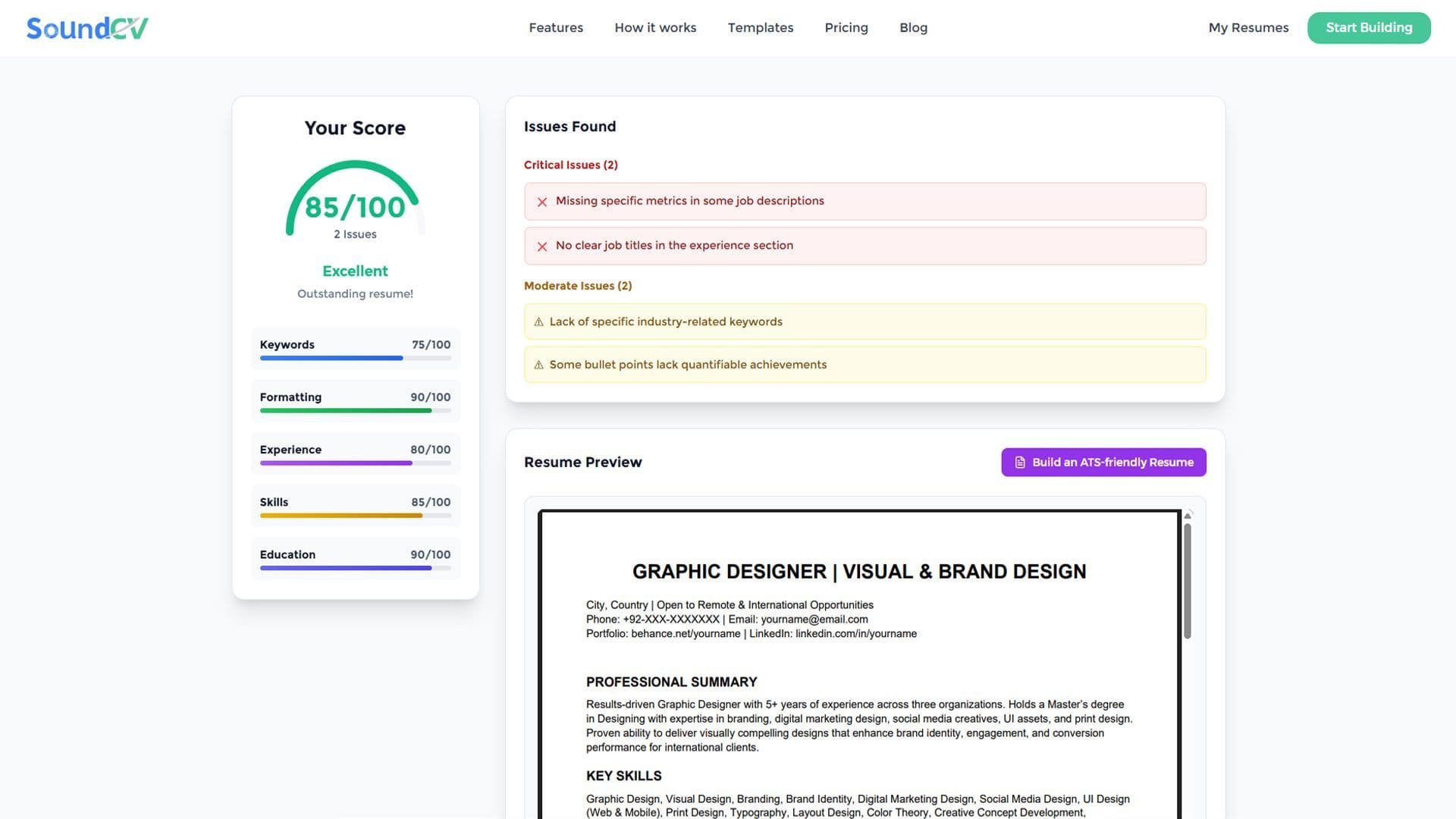
How Does the Sound CV Resume Score Checker Work?
The Sound CV Resume Score Checker analyzes your resume against ATS requirements, job-specific keywords, and structure to provide an instant, actionable score.

What Is a Sound CV? Features, Benefits, and How It Works
A Sound CV is an AI-powered resume that is tailored, ATS-optimized, and designed to showcase your skills and achievements to help you stand out to recruiters.
Zety vs Kickresume vs Novoresume vs SoundCV 2026: Which Resume Builder Is Actually Worth It?
A hands-on comparison of Zety, Kickresume, Novoresume, and SoundCV in 2026. Free plans, pricing, AI features, ATS tools, and which one to actually use.