Canada Format Resume: Complete Guide to the Canadian Resume Format (2026)
Get a free Canada-format resume template plus practical tips to help you create a polished, job-ready application.
Overview
A Canada-format resume helps you meet local hiring expectations and improves your chances of getting interviews. It should be clean, achievement-focused, and tailored to each job. Keep it one to two pages, follow Canadian spelling, avoid personal details, and showcase measurable results. Use a simple layout, match your LinkedIn profile, and always submit the resume as a PDF.
Canada Format Resume: Complete Guide to the Canadian Resume Format (2026)
The Canada format resume follows a distinct set of rules, and getting them wrong can sink your application before a recruiter reads a single line. Canadian employers want a clean, reverse-chronological resume with no photo, no personal details, and a laser focus on measurable results. This guide walks you through every section, the most common mistakes, and exactly how to format your resume for Canadian jobs in 2026.
Whether you are new to Canada, switching careers, or applying to your first Canadian job, these Canadian resume tips cover every section of the Canadian resume format with real examples and a free Canadian resume template from SoundCV. You will learn how the Canadian resume format differs from American and European resumes, how to handle bilingual applications in Quebec, and how to optimize your resume for ATS software used by Canadian employers.
What Is the Resume Format in Canada?
The Canadian resume format is a professional document, typically one to two pages long, that presents your work history in reverse chronological order. Unlike European CVs, Canadian resumes exclude personal information like age, nationality, marital status, and photos. Unlike some American resumes, Canadian resumes use British-Canadian spelling and follow specific date formatting conventions (YYYY-MM-DD).
The standard structure of a Canadian resume includes:
- Contact information (name, city/province, phone, email, LinkedIn)
- Professional summary (2 to 4 sentences)
- Work experience (reverse chronological)
- Education
- Skills
- Optional sections: certifications, volunteer work, languages
Most Canadian employers and ATS software expect this exact order. Deviating from it, for example by putting education first when you have work experience, or adding a "References available upon request" line, signals that you are unfamiliar with Canadian hiring norms.
The Canada format resume is designed around one principle: let your results speak. Canadian hiring managers are not interested in personality summaries or personal stories. They want to see what you achieved, where you did it, and whether your skills match the job posting.
One important note: in Canada, the terms "resume" and "CV" (curriculum vitae) are used interchangeably for most jobs. When employers post a job and ask for a "CV for Canada" or a "Canadian CV format", they mean the same document as a Canadian resume. The only exception is academia, medicine, and research, where a CV is a longer, comprehensive document listing publications, grants, and academic history.
If you are unsure whether to call your document a CV or a resume, or want to understand where biodata fits in, see our full guide on the difference between a CV, resume, and biodata.
Canadian Resume vs American Resume: Key Differences
The Canadian resume format looks similar to the American resume at first glance, but several critical differences separate the two. Applying with an American-style resume to a Canadian employer is one of the most common mistakes international candidates make. Here are the four key differences.
1. Spelling
Canadian English uses British spellings for certain words: "honour" not "honor", "colour" not "color", "centre" not "center", "cheque" not "check". If you are applying to jobs in Quebec and the job posting is in French, your resume should be written entirely in French. Submitting an English resume to a French-language posting signals you did not read the job advertisement carefully.
2. Date Format
Canadian resumes use the YYYY-MM date format (e.g., 2023-06 to 2025-03) rather than the American MM/DD/YYYY format. Using the wrong date format looks careless and unfamiliar to Canadian hiring managers. This is a small detail that experienced Canadian recruiters notice immediately.
3. No Personal Information
Canadian human rights legislation prohibits employers from discriminating based on age, nationality, marital status, or religion. Because of this, Canadian resumes never include a photo, date of birth or age, nationality or immigration status, marital status, or your Social Insurance Number (SIN). American resumes follow similar rules, but European and Asian resumes often include photos and personal details. If you are moving to Canada from abroad, removing this information is non-negotiable.
4. Metric Measurements
If your work experience involves measurements, use the metric system: kilometres not miles, kilograms not pounds, Celsius not Fahrenheit. This matters in fields like logistics, engineering, construction, and healthcare. A Canadian employer reading "managed a 50-mile delivery route" knows immediately that the resume was written for a different market.
How to Write a Resume in Canada: 7 Essential Sections
Every resume for Canada jobs should include these seven sections in this order. Each section has specific rules that Canadian employers expect.
Section 1: Contact Information
Your contact information goes at the top of your Canadian resume. Include your full name in bold at a larger font size (14 to 16pt), your city and province only (not your full street address), your phone number in Canadian format (e.g., 416-555-0123), a professional email address, and your LinkedIn profile URL. For technical or creative roles, add your GitHub, portfolio, or personal website URL.
Do not include your full mailing address, date of birth, SIN, or a photo. If you are still living in another country but applying to Canadian roles, you can write "Relocating to Toronto, ON" or simply list the Canadian city you are moving to. This signals to Canadian employers that you are serious about the move and will be available to work.
Section 2: Professional Summary
Your professional summary is a 2 to 4 sentence snapshot of your strongest qualifications. Write it in first person but drop the "I": lead directly with your descriptor. Here is the difference between a weak and strong Canadian resume summary.
Weak: "I am a dedicated professional with experience in marketing and communications."
Strong: "Marketing manager with 7 years of experience in B2B SaaS, specializing in demand generation. Grew pipeline by 43% in 2024 by restructuring HubSpot workflows and launching LinkedIn Ads targeting mid-market IT decision-makers. Fluent in English and French."
The strong version gives a specific result (43% pipeline growth), names a tool (HubSpot), specifies the market (B2B SaaS), and mentions bilingual ability. These are all details a Canadian hiring manager filters for in the first 10 seconds of reading a resume.
Section 3: Work Experience
Work experience is the most important section on a Canadian resume. List jobs in reverse chronological order, most recent first. For each role, include the job title in bold, the company name, city, and province, the dates in YYYY-MM format, and 3 to 6 bullet points of accomplishments.
Each bullet point should follow the CAR format: Context, Action, Result. Start every bullet with a strong action verb: "Reduced", "Led", "Built", "Increased", "Managed". Quantify wherever possible, whether percentages, dollar amounts, team sizes, or time saved.
Strong bullet point example: "Reduced customer onboarding time by 35% by building an automated email sequence in Salesforce, resulting in a 12% increase in 90-day retention."
Weak bullet point example: "Responsible for managing customer onboarding process."
If you are a new immigrant to Canada with work experience from another country, list that experience exactly as you would Canadian experience. Convert currencies to Canadian dollars, convert measurements to metric, and use YYYY-MM date formatting. Canadian employers accept international work experience fully. The format just needs to match Canadian conventions.
Section 4: Education
List degrees and diplomas in reverse chronological order. For each, include the degree name and major, the institution name and location (city, province or country), the graduation date in YYYY-MM format, your GPA only if it is 3.7 out of 4.0 or higher and you graduated within the last three years, and relevant coursework only for recent graduates who have no relevant work experience to fill the page.
If you have a degree from outside Canada, you may want to add a note such as "Equivalent to a Canadian Bachelor's degree, verified by World Education Services (WES)". This helps Canadian hiring managers understand your qualification level without having to research the foreign institution.
Section 5: Skills
List 8 to 12 skills that match the specific job description. Split them between hard skills and soft skills, but weight the section heavily toward hard skills. Canadian hiring managers and ATS filters are looking for specific technical competencies, not personality traits.
Strong examples of hard skills valued in the Canadian job market include bilingualism in English and French (highly valuable in federal government, banking, and Quebec employers), software tools like Python, Tableau, AutoCAD, SAP, or QuickBooks, professional certifications like PMP, CPA, P.Eng., or Red Seal trades certification, and industry platforms like Shopify, HubSpot, JIRA, or AWS.
Soft skills like "team player" and "strong communicator" add nothing unless backed up with evidence in your work experience bullets. If you want to demonstrate communication skills, show a result: "Presented quarterly performance reports to a board of 12 executives, leading to a $500K budget approval."
Section 6: Certifications and Licenses (Optional)
If you hold professional certifications or trade licenses, list them in a separate section. This matters in regulated professions like engineering (P.Eng.), accounting (CPA), nursing (RN), teaching, and skilled trades (Red Seal). For each certification, include the certification name, the issuing organization, the date obtained, and the expiry date if applicable.
Regulated professions in Canada require provincial licensing even if you are already certified in your home country. Engineers must apply through their provincial engineering body such as PEO in Ontario or APEGA in Alberta. Foreign-trained doctors, nurses, and teachers have separate credential recognition pathways. Listing a foreign certification without noting the Canadian recognition status can cause confusion. Clarify it proactively.
Section 7: Volunteer Work (Optional)
Volunteer experience is valued highly in Canada, particularly for new immigrants and recent graduates who lack Canadian work experience. List it in the same format as paid work experience: organization name, role title, dates, and 2 to 3 accomplishment bullets.
If you have volunteered with settlement services, community organizations, or Canadian non-profits, this signals local integration, something Canadian employers value when hiring newcomers. A volunteer section showing Canadian community involvement tells the hiring manager that you understand Canadian workplace culture and have already begun building local connections.
Resume Format for Immigrants in Canada: A Step-by-Step Adaptation Guide
If you have recently immigrated to Canada or are applying for jobs through an Express Entry or Provincial Nominee Program, formatting your resume correctly is critical. A resume that looks "international," with a photo, date of birth, or incorrect date format, will often be automatically rejected or viewed less favorably by hiring managers.
Here is how to adapt your resume to the Canadian format as an immigrant:
Remove all personal information. Photo, age, marital status, nationality: delete all of it. Canada's human rights laws protect you from hiring discrimination, and resumes that include this information can make HR departments uncomfortable, which is the last thing you want when applying for jobs.
Get your credentials recognized. If you have degrees or professional designations from outside Canada, check whether they need formal recognition or evaluation. For engineers, you need to apply through your provincial engineering body. For foreign-trained doctors, nurses, and teachers, there are separate credential recognition pathways. Adding "recognized by WES" or your professional body next to your credential shows Canadian employers your qualification is verified and comparable to a Canadian standard.
Convert your work experience into Canadian context. If you managed a team of 20 in your home country, say so. If you ran a budget equivalent to CAD $2 million, convert it to Canadian dollars. Do not assume employers will know the scale or context of your previous roles at international companies. Canadian hiring managers may not be familiar with the size or reputation of a company that is well-known in your home country.
Add a Canadian address or a relocation note. Even if you are still abroad, listing the Canadian city where you are settling shows employers you have committed to the move and will not need visa sponsorship. This removes a major uncertainty from the hiring decision.
Highlight bilingualism if you speak French. French-English bilingualism is a significant asset in the federal public service, banking, and any role based in Quebec, Ottawa, or New Brunswick, Canada's only officially bilingual province. If you are proficient in French, make it prominent in both your professional summary and your skills section.
Once you have formatted your resume for the Canadian market, use SoundCV's free ATS resume checker to see how your resume scores against the ATS filters used by Canadian employers. You get an instant score and a specific list of what to fix before you send your first application.
ATS Resume Canada: How to Format Your Resume for Applicant Tracking Systems
Most mid-to-large Canadian employers now use Applicant Tracking System (ATS) software to screen resumes before a human ever reads them. This means your Canadian resume needs to pass ATS filters before it reaches a recruiter's inbox. Here is what ATS systems check for and how to format your resume accordingly.
Keyword Matching
ATS software compares your resume to the job posting word by word. If the posting says "project management" and your resume says "project coordination", some ATS systems will not count it as a match. Copy exact phrases from the job description into your resume, especially job titles, required skills, and tools. If the job posting says "bilingual French-English" and you are bilingual but did not list it in your skills section, you will be filtered out despite being qualified.
Standard Section Headings
ATS systems are programmed to recognize headings like "Work Experience", "Education", "Skills", and "Summary". If you call your experience section "My Career Journey" or "Professional Background", the ATS may not recognize it and will fail to parse your experience correctly. Stick to standard headings that match what ATS systems expect.
Clean Single-Column Layout
Avoid tables, text boxes, headers/footers, graphics, and multi-column layouts. ATS systems read resumes as plain text files, and any complex formatting creates parsing errors. Use a single-column layout with standard fonts such as Arial, Calibri, or Georgia at 10 to 12pt. Do not put your contact details in Word's header area. Many ATS systems cannot read text placed there, which means your name and phone number become invisible to the system.
File Format
Submit as a .docx or PDF depending on what the employer requests. If they do not specify, .docx is generally safer for ATS parsing. PDF is fine for companies using modern ATS systems like Workday, Greenhouse, or Lever, but older systems struggle with PDFs. When in doubt, submit both and note in your email which version is the ATS-optimized one.
To check whether your resume passes ATS filters used by Canadian employers, run it through SoundCV's resume score checker. The tool reads your resume the same way ATS software does and flags every section that could cause a parsing failure or keyword miss. You can also learn how ATS software works in detail in our ATS scanner guide.
Canadian Resume Templates: Reverse Chronological, Functional, or Combination?
There are three main resume formats used in Canada. Most Canadian job seekers should use the reverse chronological format, but here is when each format makes sense for your situation. If you want a deep dive into how the chronological format works, read our complete guide to the chronological resume format.
Reverse Chronological Resume (Recommended for Most Candidates)
This is the most widely used and accepted Canadian resume template format. It lists your most recent job first and works backwards through your history. Canadian hiring managers prefer it because it shows career progression at a glance and is easy for ATS systems to parse.
Best for: Anyone with a consistent work history, career changers with relevant past experience, and immigrants with professional experience from abroad who are adapting their resume to the Canadian market.
Functional Resume (Skills-Based)
A functional resume groups your experience by skill category rather than by employer and date. It can hide employment gaps, but it is often viewed with suspicion by Canadian recruiters. It is hard to tell when and where you gained each skill, and hiring managers may ask for a chronological version anyway. Functional resumes also fail ATS parsing more often because the structure does not match expected patterns.
Best for: Career changers who want to emphasize transferable skills. Use it cautiously, and be prepared to provide a chronological version if requested.
Combination Resume
A combination resume opens with a skills summary, then moves into reverse-chronological work experience. It gives you the benefits of both formats: skills visibility at the top plus a clear employment timeline below. This format works well for senior professionals who want to frame their expertise before diving into their history.
Best for: Senior professionals with 10 or more years of experience, people returning to work after a long gap, or candidates applying to executive leadership roles where a skills overview at the top adds strategic value.
Whatever format you choose, SoundCV's resume templates are built for ATS compatibility. Each template is single-column, cleanly formatted, and tested against the ATS systems used by top Canadian employers including federal government, major banks, and large private-sector companies.
Canadian Resume Length and Layout Rules for 2026
How long should a Canadian resume be? The answer depends on your experience level. Here are the rules Canadian recruiters expect you to follow.
- 0 to 3 years of experience: 1 page maximum. You do not have enough content to fill two pages meaningfully, and trying to do so looks like padding.
- 3 to 10 years of experience: 1 to 2 pages. One tight page is still ideal, but two pages are acceptable if every line adds value.
- 10 or more years of experience: 2 pages. Never 3 pages unless you are in academia or a field where publications and grants are listed. In that case you are writing a CV, not a resume.
Layout rules for your Canadian resume in 2026:
- Margins: 0.75 to 1 inch on all sides
- Font size: 10 to 12pt for body text; 14 to 16pt for your name
- Font family: Arial, Calibri, Georgia, or Garamond (no decorative or script fonts)
- Line spacing: 1.15 within sections; extra spacing between section headings
- Bullet points: use solid circles or simple dashes (no checkmarks, arrows, or custom icons)
- Colour: black text on white background for ATS; subtle colour accents are acceptable for design or creative roles only
Bilingual Resume Format: French and English Resumes in Canada
Canada is officially bilingual, and the language of your resume matters depending on where and what you are applying for. Getting this wrong is a common mistake among newcomers and international applicants.
Applying in Quebec: If the job posting is in French, your resume must be in French. Submitting an English resume to a French-language posting signals either that you did not read the advertisement or that you do not speak French well enough to write a resume in it. Both interpretations hurt your application. If the posting is bilingual, submit a French resume and note in your cover letter that you are fluent in both languages.
Applying in New Brunswick: New Brunswick is Canada's only officially bilingual province. Federal government roles and many provincial public service jobs require both official languages. A bilingual resume listing "Bilingual: English (Native) / French (Professional)" in your skills section is a real competitive differentiator here, and it demonstrates awareness of the regional context.
Applying to the Federal Government of Canada: The Government of Canada hires for bilingual-designated positions classified at language levels A, B, or C for reading, writing, and oral proficiency in each language. If you are applying to a bilingual-designated position, note your language levels explicitly in your skills or certifications section, for example: "French: CBC (reading C, writing B, oral C)".
Applying in English Canada (Ontario, BC, Alberta): English is the language of business in these provinces. Write your resume in English and note French proficiency in your skills section as an asset. Do not write separate French and English versions unless the posting specifically requests it.
If you are writing a French resume for Quebec, the structure is identical to the English Canadian format: same sections, same order, same rules about excluding photos and personal information. The only differences are the language itself and the spelling conventions of French.
Canadian Resume Format for New Graduates
Writing a Canadian resume with little or no full-time work experience is challenging, but it is not impossible. Here is how new graduates should approach the Canadian resume format to compete with more experienced candidates.
Lead with education. New graduates are one of the few exceptions to the "work experience first" rule. If you graduated within the last two years and lack full-time work experience, move your education section above work experience. Include relevant coursework, thesis or capstone projects, academic awards, and your GPA if it is 3.7 out of 4.0 or higher.
Treat co-op and internships like real jobs. Canadian universities often include co-op programs, internships, or practicum placements in their degree programs. These count as real professional experience on your resume. List them in the same format as paid jobs: company name, city, job title, dates in YYYY-MM format, and 3 to 4 accomplishment bullets with numbers where possible.
Quantify everything you can. Even if your experience is limited, look for numbers: "Coordinated a team of 8 volunteers for a campus food drive that collected 1,200 kg of food donations", "Achieved a 4.0 GPA in the final semester while completing a 4-month co-op placement", "Reduced report generation time by 20% during my internship by building an Excel macro".
Write a targeted professional summary. Your professional summary as a new graduate should highlight your degree, your area of specialization, and your most relevant project or achievement. Example: "Recent Computer Science graduate from the University of Waterloo with a specialization in machine learning. Built a sentiment analysis model during a co-op placement at a Toronto fintech startup that reduced customer churn flag time by 22%." For more examples tailored to students and new entrants, see our guide to resume summaries for freshers.
Keep it to one page. A new graduate has no reason to fill a second page. If your resume is spilling onto a second page, cut the weakest bullet points, reduce your skills list, and remove the objective statement if you have one. A tight, focused one-page resume signals good judgment and writing ability, both of which Canadian employers value.
After building your first Canadian resume, use SoundCV's AI resume builder to strengthen each section. The AI suggests stronger action verbs, adds missing keywords from your target job postings, and restructures weak bullet points into CAR-format accomplishments that pass ATS filters.
Common Mistakes That Get Canadian Resumes Rejected
These are the most common mistakes that get Canadian resumes filtered out before a recruiter ever sees them, and how to fix each one.
1. Including a photo. Never put a photo on a Canadian resume. Not a professional headshot, not a LinkedIn thumbnail. Canadian HR departments will discard resumes with photos to avoid any perception of bias. The only exception is acting, modelling, or entertainment roles where appearance is directly relevant to the work.
2. Using American spellings. Words like "honor", "color", and "organize" stand out to Canadian hiring managers because the Canadian spellings are "honour", "colour", and "organise". Run your document through a spell checker set to Canadian English before submitting.
3. Writing "References available upon request." This line wastes space and tells the hiring manager nothing. Everyone can provide references if asked. Remove it and use the space for an extra accomplishment bullet instead.
4. Using a non-professional email address. A professional email matters: firstname.lastname@gmail.com is fine. "partyguy88@hotmail.com" is not. Create a new professional email account if needed before you start applying.
5. Sending the same resume to every job. Canadian job postings are ATS-screened with job-specific keywords. A generic resume will fail keyword matching for most postings. At minimum, customize your skills section and the first two bullet points of your most recent job for each application.
6. Vague bullet points without results. "Responsible for managing a team" tells the hiring manager nothing. "Led a cross-functional team of 6 to deliver a 1.2 million dollar software migration project 3 weeks ahead of schedule" tells them exactly what you can do. Quantify every achievement you can, even if the numbers feel small.
7. Wrong date format. Using 03/2024 to 01/2025 instead of 2024-03 to 2025-01 is a small detail that signals unfamiliarity with Canadian conventions. Fix it across every job entry and every education entry.
8. Missing keywords from the job posting. If the job posting says "bilingual French-English" and you are bilingual but did not include it in your skills section, an ATS system will screen you out despite your qualification. Read the job posting carefully and mirror its exact language for skills, tools, and certifications.
Canadian Resume Format Sample: What a Strong Resume Looks Like
A canadian resume format sample helps you understand exactly what Canadian employers expect before you start writing. Below is a before-and-after comparison of a real resume entry so you can see the difference between a weak international-style resume and a strong Canadian-style resume.
BEFORE (weak, typical international resume style):
- Name: Ahmed Khan | DOB: 15 March 1990 | Nationality: Pakistani
- Responsible for managing a sales team
- Worked on increasing revenue for the company
- March 2021 to January 2024
AFTER (strong, Canadian style resume):
- Name: Ahmed Khan | Toronto, ON | ahmed.khan@gmail.com | 416-555-0198
- Led a sales team of 9 representatives across Ontario and Quebec, closing CAD $3.2M in annual recurring revenue in 2023
- Grew territory revenue by 28% in 12 months by introducing a structured follow-up cadence in Salesforce
- 2021-03 to 2024-01
The differences are immediate: no personal details, Canadian date format, metric-compatible numbers in CAD, and every bullet point shows a result with a specific number. This is what a Canadian resume format sample should look like across every work experience entry.
A strong canadian style resume also applies this same discipline to the professional summary, skills section, and education section. Vague descriptions are replaced with outcomes. Dates are standardised. Personal information is removed completely.
If you want to see how your own resume compares to this standard, run it through SoundCV's free resume scorer. You will get a line-by-line breakdown of what needs to change to match what Canadian employers expect.
Frequently Asked Questions About the Canadian Resume Format
What is the standard resume format in Canada?
The standard Canadian resume format is reverse chronological: your most recent job appears first, followed by older roles in order. The standard sections are contact information, professional summary, work experience, education, and skills. Canadian resumes never include photos, date of birth, nationality, or marital status. Length is one to two pages depending on experience, and dates follow the YYYY-MM format throughout the document.
How long should a Canadian resume be?
A Canadian resume should be one page for candidates with fewer than five years of experience and two pages for candidates with more. New graduates should stay at one page even if they need to cut sections to get there. Senior professionals and executives with 10 or more years of experience can use two pages, but three-page resumes are only appropriate for academic CVs that list publications and research grants. Padding a resume to fill a second page signals poor judgment to Canadian hiring managers.
Should I include a photo on my Canadian resume?
No. Canadian employers do not expect or want a photo on your resume. Including one can work against you because HR departments often discard resumes with photos to avoid any appearance of bias-based hiring. Canada's human rights legislation is designed to ensure fair hiring practices, and photos undermine that principle. The only exception is acting, modelling, or entertainment work where physical appearance is directly relevant to the role you are applying for.
What is the difference between a Canadian resume and an American resume?
Canadian and American resumes are structurally similar but differ in four ways: spelling (Canadian English uses British spellings like "colour" and "honour"), date format (Canada uses YYYY-MM while the US uses MM/DD/YYYY), measurements (Canada uses metric: kilometres, kilograms, Celsius), and personal information rules (both countries avoid photos and personal details, but this is more rigidly enforced in Canada due to provincial human rights codes). Canadian resumes also often highlight bilingualism in English and French as a competitive asset.
How do I write a professional summary for a Canadian resume?
A Canadian resume professional summary is 2 to 4 sentences. Open with your years of experience and area of expertise. Add your strongest quantifiable achievement. Close with a differentiating factor like bilingualism, a key certification, or a specific industry niche. Do not start with "I am a". Drop the subject and lead with the descriptor: "Senior project manager with 8 years in construction..." not "I am a senior project manager with 8 years...". Keep it to four sentences maximum and make every sentence earn its place.
What is the best Canadian resume format for new graduates?
New graduates in Canada should use a reverse-chronological format with education listed before work experience. Include co-op placements, internships, volunteer work, and academic projects as experience entries with accomplishment bullets. Keep the resume to one page. Quantify achievements wherever possible, including team size, project outcomes, GPA, and fundraising amounts. Use a clean, ATS-compatible single-column template and tailor your skills section to each job posting using exact keywords from the job description.
How do I format a bilingual resume in Canada?
A bilingual resume in Canada does not mean writing everything twice in both languages. Write your resume in the language of the job posting: French for French-language postings, English for English-language postings. List your language proficiency in the skills section: "Bilingual: English (Native) / French (Professional Working Proficiency)" or your Government of Canada language levels such as CBC. For federal government bilingual-designated positions, list your assessed language levels explicitly. Only apply to roles that genuinely require both languages, as bilingual-designated positions are highly competitive.
What skills should I include in a Canadian resume?
List 8 to 12 skills that match the specific job posting you are applying to. Prioritize hard skills over soft skills: software tools, programming languages, professional certifications, industry-specific systems, and language proficiency. Soft skills like "communication" and "leadership" add no value in the skills section unless backed by specific evidence in your work experience bullets. For federal government positions, include both official languages and any professional certifications. Skilled trades candidates should list Red Seal certifications prominently at the top of their skills section.
How do I list foreign credentials on a Canadian resume?
List your foreign degree exactly as you would a Canadian degree, then add a parenthetical note: "(Equivalent to a Canadian Bachelor of Science, verified by World Education Services)". If you have not yet had your credentials evaluated by WES or your relevant professional body, do so before applying to regulated professions like engineering, medicine, nursing, law, or teaching. Unrecognized foreign credentials are the top barrier to employment for newcomers to Canada, and proactively addressing this on your resume removes a major uncertainty from the hiring manager's decision.
Is SoundCV free for creating and checking a Canadian resume?
Yes. SoundCV's resume score checker is free to use. Upload your resume and SoundCV reads it the same way ATS software used by Canadian employers does. You get an instant score and a specific list of what to fix: missing keywords, formatting problems that cause ATS parsing failures, weak bullet points, and sections that need strengthening. The AI resume builder then helps you act on every fix without starting from scratch, so your Canadian resume is both ATS-ready and compelling to human reviewers.
Ready to build or optimize your Canadian resume? Check your resume score free on SoundCV and see exactly what Canadian employers and ATS systems see when your application arrives. You will get a score, a fix list, and the specific changes that will move your resume from rejected to shortlisted.
Related Blogs
Explore more insights and guides you might like.
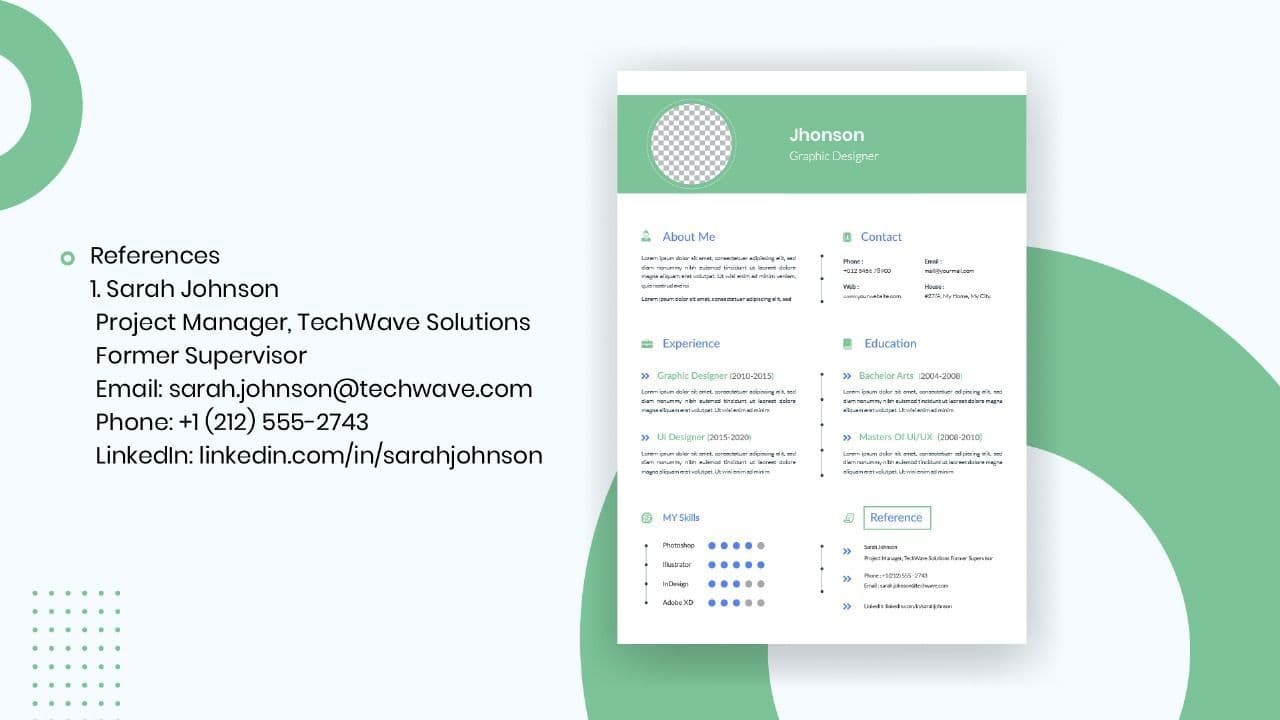
How to List References on a Resume in 2026
Learn the modern 2026 approach to listing references on your resume for maximum professionalism and recruiter impact.

Is Sound CV good for students and fresh graduates with no experience?
Sound CV is perfect for students and fresh graduates, helping them create professional resumes that highlight skills, projects, and potential even with little or no work experience.
Why Sound CV Is Different from Other AI Resume Builders
Sound CV stands out by creating job-focused, ATS-friendly resumes that highlight real achievements, not just generic content.

Resume Format for HR Job: Professional Guide and Sample Templates
A complete guide to the best resume format for HR jobs, with expert tips and sample templates to help you create a professional and job-ready resume.
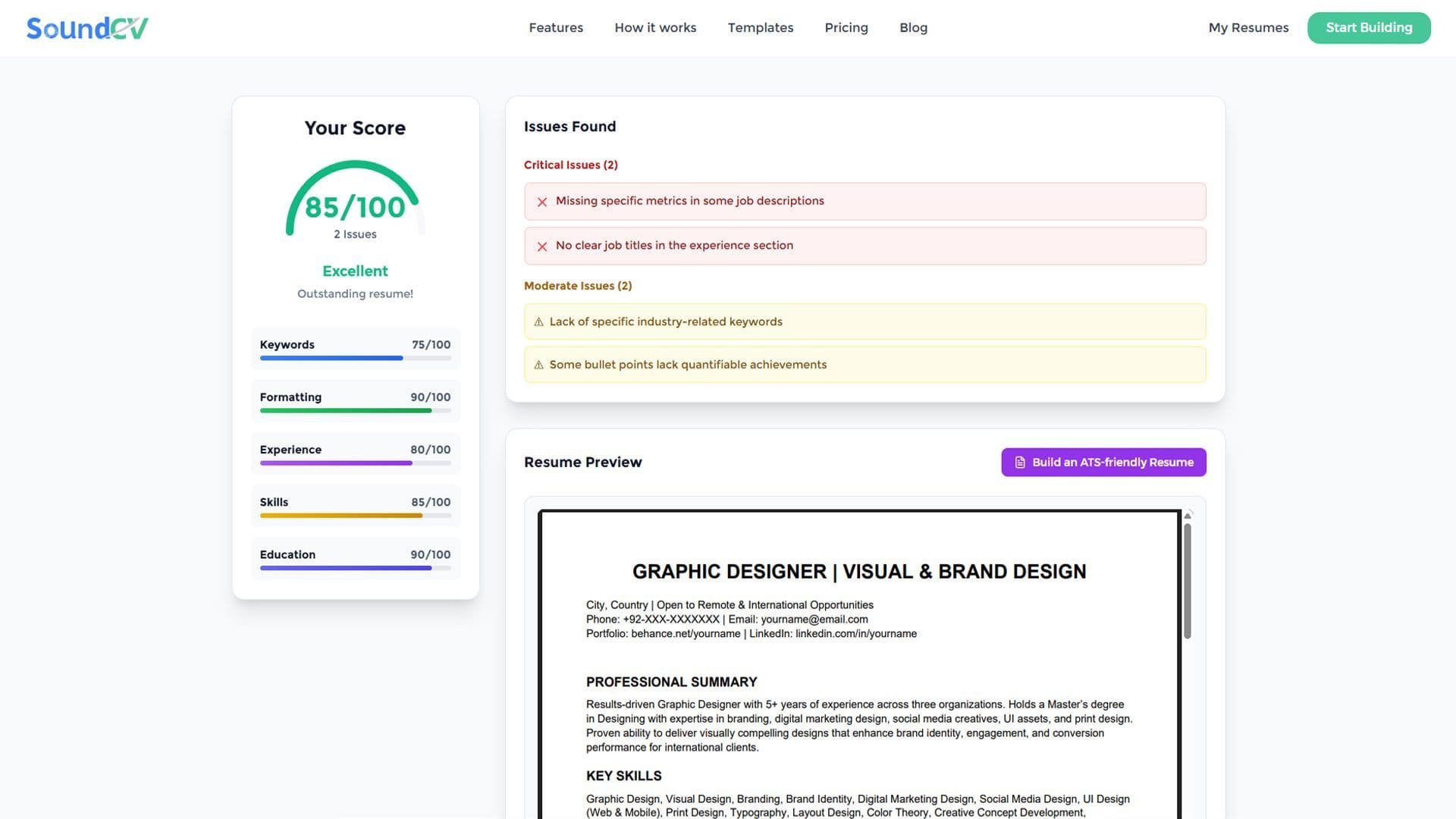
How Does the Sound CV Resume Score Checker Work?
The Sound CV Resume Score Checker analyzes your resume against ATS requirements, job-specific keywords, and structure to provide an instant, actionable score.

What Is a Sound CV? Features, Benefits, and How It Works
A Sound CV is an AI-powered resume that is tailored, ATS-optimized, and designed to showcase your skills and achievements to help you stand out to recruiters.