Python Interview Questions and Answers (Complete Guide for Beginners & Experts)
Comprehensive Python interview questions and answers guide covering basics, advanced concepts, and expert tips to help you land your dream job.
Overview
Master Python interviews with this complete guide featuring commonly asked questions, clear explanations, real examples, and expert tips. Perfect for beginners and experienced developers preparing for technical interviews.
Are you gearing up for a Python interview and feeling the nerves kick in? You are not alone. Python has become one of the most in-demand programming languages in the world, powering everything from web development and data science to artificial intelligence and automation. That also means competition for Python roles is fierce, and being well-prepared with the right Python interview questions and answers can make all the difference between landing the job and going back to the drawing board.
This complete guide covers the most commonly asked Python interview questions and answers, from beginner-level basics to advanced topics that senior developers are expected to know. Whether you are applying for your first developer role or looking to level up to a senior engineering position, this guide has you covered with clear explanations, practical examples, and tips to impress any interviewer.
Key Points
- Covers beginner to advanced Python interview questions
- Includes real coding examples and explanations
- Explains OOP, generators, GIL, and decorators
- Helps improve problem-solving and coding skills
- Includes expert tips to crack interviews
- Ideal for freshers and experienced developers
- Focus on practical and real-world scenarios
Why Python Skills Matter in Today's Job Market
Before diving into the Python interview questions and answers themselves, it is worth understanding why Python expertise is so valuable right now. According to multiple industry surveys, Python consistently ranks among the top three most popular programming languages globally. Its readability, versatility, and massive ecosystem of libraries make it the language of choice across industries.
Employers hiring Python developers typically look for candidates who understand not just the syntax, but also the underlying concepts of how memory management works, what makes Python code Pythonic, and how to write efficient, maintainable code. That is exactly what the Python interview questions and answers in this guide are designed to help you demonstrate.
Also Read : Good CV Examples for Your First Job
Python Interview Questions and Answers: Core Language Basics
Every Python interview starts with the fundamentals. These questions test whether you have a solid understanding of the language before moving on to more complex topics.
What are the key features of Python?
Python is an interpreted, high-level, general-purpose programming language. Its key features include:
- Readability: Python's clean syntax resembles plain English, making code easier to write and understand.
- Dynamic Typing: Variable types are determined at runtime, not at compile time.
- Extensive Standard Library: Python ships with a rich library covering file handling, networking, regular expressions, and much more.
- Cross-Platform Compatibility: Python runs on Windows, macOS, and Linux without modification.
- Support for Multiple Paradigms: Python supports object-oriented, procedural, and functional programming styles.
- Garbage Collection: Python handles memory management automatically using reference counting and a cyclic garbage collector.
What is the difference between a list and a tuple in Python?
This is one of the most frequently asked Python interview questions and answers, and for good reason understanding mutable vs immutable data structures is fundamental.
A list is mutable, meaning you can change its elements after creation. A tuple is immutable — once created, its elements cannot be changed.
python
# List - mutable
my_list = [1, 2, 3]
my_list[0] = 10 # This works fine
print(my_list) # Output: [10, 2, 3]
# Tuple - immutable
my_tuple = (1, 2, 3)
my_tuple[0] = 10 # This raises a TypeError
When to use which? Use tuples when you want to ensure data integrity and lists when you need a collection that may change over time. Tuples are also slightly faster than lists due to their immutability.
Also Read : Resume for Hotel Job With No Experience (Guide + Example)
What is the difference between == and is in Python?
- == checks for value equality do the two objects have the same value?
- is checks for identity do the two variables point to the same object in memory?
python
a = [1, 2, 3]
b = [1, 2, 3]
print(a == b) # True same values
print(a is b) # False different objects in memory
c = a
print(a is c) # True same object
What are Python decorators?
A decorator is a function that takes another function as input, extends or modifies its behavior, and returns a new function all without explicitly modifying the source function. Decorators are widely used in Python for logging, authentication, caching, and more.
python
def log_function_call(func):
def wrapper(*args, **kwargs):
print(f"Calling function: {func.__name__}")
result = func(*args, **kwargs)
print(f"Function {func.__name__} completed")
return result
return wrapper
@log_function_call
def add_numbers(a, b):
return a + b
add_numbers(3, 4)
# Output:
# Calling function: add_numbers
# Function add_numbers completed
Also Read : CV Format for Dubai Jobs: Examples, Writing Tips & UAE Resume Guide
Python Interview Questions and Answers: Object-Oriented Programming
Object-oriented programming (OOP) is a core part of Python, and interviewers love to probe a candidate's depth of understanding here. These Python interview questions and answers cover the most critical OOP concepts.
What are the four pillars of OOP in Python?
1. Encapsulation — Bundling data and the methods that operate on that data into a single unit (class), and restricting access to internal state.
2. Inheritance — A class (child) can inherit attributes and methods from another class (parent), promoting code reuse.
3. Polymorphism — The same method name can behave differently depending on the object it is called on.
4. Abstraction — Hiding complex implementation details and showing only the necessary interface to the user.
What is the difference between __init__ and __new__ in Python?
- __new__ is responsible for creating a new instance of a class. It is called before __init__.
- __init__ is responsible for initializing the newly created instance.
In practice, you will almost always use __init__. __new__ is only overridden in advanced scenarios, such as when implementing singleton patterns or working with immutable types like str or tuple.
python
class MyClass:
def __new__(cls, *args, **kwargs):
print("Creating instance")
return super().__new__(cls)
def __init__(self, name):
print("Initializing instance")
self.name = name
obj = MyClass("Python")
# Output:
# Creating instance
# Initializing instance
Also Read : How to Make a Resume for a Teacher Job | Step-by-Step Guide
What is multiple inheritance and how does Python handle it?
Multiple inheritance allows a class to inherit from more than one parent class. Python uses the Method Resolution Order (MRO) specifically the C3 linearization algorithm to determine the order in which base classes are searched when looking up an attribute or method.
python
class A:
def greet(self):
return "Hello from A"
class B(A):
def greet(self):
return "Hello from B"
class C(A):
def greet(self):
return "Hello from C"
class D(B, C):
pass
d = D()
print(d.greet()) # Output: Hello from B
print(D.__mro__) # Shows the resolution order
You can always inspect the MRO of a class using ClassName.__mro__ or ClassName.mro().
Also Read : 2 Year Experience Resume Format (Free Template + Pro Tips)
Python Interview Questions and Answers: Advanced Concepts
Once you have cleared the basics, interviewers will push you into deeper waters. These are the Python interview questions and answers that separate good candidates from great ones.
What is a generator in Python and why would you use one?
A generator is a special type of iterator that yields values one at a time using the yield keyword, instead of returning all values at once. Generators are memory-efficient because they generate values on the fly rather than storing the entire sequence in memory.
python
# Regular function — stores all values in memory
def get_squares_list(n):
return [x ** 2 for x in range(n)]
# Generator — yields one value at a time
def get_squares_generator(n):
for x in range(n):
yield x ** 2
# With 1 million numbers, the generator uses a fraction of the memory
gen = get_squares_generator(1_000_000)
print(next(gen)) # Output: 0
print(next(gen)) # Output: 1
Generators are especially useful when working with large datasets, file processing, or any scenario where you do not need all values at once.
Also Read : Indian Resume Format (Free Template + Pro Tips) | Resume Guide for Indian Job Seekers
What is the difference between *args and **kwargs?
- *args allows a function to accept any number of positional arguments as a tuple.
- **kwargs allows a function to accept any number of keyword arguments as a dictionary.
python
def show_args(*args, **kwargs):
print("Positional args:", args)
print("Keyword args:", kwargs)
show_args(1, 2, 3, name="Alice", role="Developer")
# Output:
# Positional args: (1, 2, 3)
# Keyword args: {'name': 'Alice', 'role': 'Developer'}
Also Read : Where to Put GPA on a Resume (Best Placement + Examples)
How does Python's Global Interpreter Lock (GIL) work?
The GIL is a mutex that allows only one thread to execute Python bytecode at a time, even on multi-core processors. This is a common topic in Python interview questions and answers because it has important implications for multi-threaded Python applications.
The GIL exists to protect CPython's memory management, which is not thread-safe by default. In practice, this means:
- CPU-bound tasks (heavy computation) do not benefit much from Python's threading due to the GIL.
- I/O-bound tasks (network calls, file reads) can still benefit from threading because the GIL is released during I/O operations.
For true parallel execution of CPU-bound tasks in Python, the recommended approach is to use the multiprocessing module, which spawns separate processes — each with its own GIL.
Also Read : ATS-Friendly Marketing Resume Keywords With Examples
What are list comprehensions and when should you use them?
List comprehensions provide a concise way to create lists based on existing iterables. They are generally faster than equivalent for loops and are considered more "Pythonic."
python
# Traditional loop
squares = []
for x in range(10):
if x % 2 == 0:
squares.append(x ** 2)
# List comprehension — same result, cleaner syntax
squares = [x ** 2 for x in range(10) if x % 2 == 0]
print(squares) # Output: [0, 4, 16, 36, 64]
However, if the logic becomes complex with nested conditions and multiple transformations, a regular loop may be more readable. Clarity should always come first.
Also Read : How Long Is a CV? Ideal Length by Career Stage, Industry & Country
Python Interview Questions and Answers: Error Handling and File Operations
Practical programming skills matter just as much as theoretical knowledge. These Python interview questions and answers test how you handle real-world scenarios.
How does exception handling work in Python?
Python uses try, except, else, and finally blocks to handle exceptions gracefully.
python
def divide(a, b):
try:
result = a / b
except ZeroDivisionError:
print("Error: Cannot divide by zero")
return None
except TypeError as e:
print(f"Type error occurred: {e}")
return None
else:
print("Division successful")
return result
finally:
print("This block always runs")
divide(10, 2)
# Output:
# Division successful
# This block always runs
divide(10, 0)
# Output:
# Error: Cannot divide by zero
# This block always runs
The else block runs only if no exception occurred. The finally block always runs, making it ideal for cleanup tasks like closing files or database connections.
What is the difference between read(), readline(), and readlines()?
When working with files, these three methods serve different purposes:
- read() reads the entire file as a single string.
- readline() reads one line at a time each time it is called.
- readlines() reads all lines and returns them as a list of strings.
python
with open("example.txt", "r") as f:
content = f.read() # Entire file as one string
with open("example.txt", "r") as f:
line = f.readline() # First line only
with open("example.txt", "r") as f:
lines = f.readlines() # List of all lines
Always use the with statement when working with files. It ensures the file is properly closed even if an exception occurs.
Also Read : Best Resume Action Verbs for 2026 (ATS-Optimized Guide)
What are Python's built-in data structures?
Python provides four primary built-in data structures:
- List (list) Ordered, mutable, allows duplicates.
- Tuple (tuple) Ordered, immutable, allows duplicates.
- Dictionary (dict) Unordered (insertion-ordered in Python 3.7+), mutable, key-value pairs with unique keys.
- Set (set) Unordered, mutable, no duplicates.
python
# Dictionary example
student = {"name": "Ali", "age": 22, "grade": "A"}
print(student["name"]) # Output: Ali
# Set example automatically removes duplicates
numbers = {1, 2, 2, 3, 3, 4}
print(numbers) # Output: {1, 2, 3, 4}
Python Interview Questions and Answers: Python for Data Science and Web Development
Many Python roles today are specialized you may be interviewing for a data engineering position, a backend web developer role, or a machine learning engineering job. These Python interview questions and answers address domain-specific knowledge.
What Python libraries are commonly used for data science?
The most widely used Python libraries in data science include:
- NumPy — Numerical computing with multi-dimensional arrays and matrices.
- Pandas — Data manipulation and analysis with DataFrames.
- Matplotlib / Seaborn — Data visualization.
- Scikit-learn — Machine learning algorithms and utilities.
- TensorFlow / PyTorch — Deep learning frameworks.
python
import pandas as pd
# Creating a simple DataFrame
data = {"Name": ["Alice", "Bob", "Charlie"],
"Score": [95, 87, 92]}
df = pd.DataFrame(data)
print(df[df["Score"] > 90])
# Output:
# Name Score
# 0 Alice 95
# 2 Charlie 92
What is Flask and how does it differ from Django?
Both Flask and Django are popular Python web frameworks, but they serve different purposes:
Flask is a lightweight, micro-framework. It gives developers maximum flexibility and is ideal for building small to medium-sized web applications and REST APIs. It comes with minimal built-in features, so you add libraries as needed.
Django is a full-stack, batteries-included framework. It comes with an ORM, admin panel, authentication, and many other features out of the box. It is better suited for larger, more complex web applications.
python
# A basic Flask app
from flask import Flask
app = Flask(__name__)
@app.route("/")
def home():
return "Hello, World!"
if __name__ == "__main__":
app.run(debug=True)
The choice between Flask and Django often comes down to project complexity and team preference. Both are excellent, and knowing either — or both — is a major asset in Python interviews.
Also Read : How to Use ChatGPT to Write a Resume: A Complete Step-by-Step Guide
What is the difference between shallow copy and deep copy?
- A shallow copy creates a new object but inserts references to the objects found in the original. Changes to nested objects affect both the copy and the original.
- A deep copy creates a completely independent copy, including all nested objects.
python
import copy
original = [[1, 2, 3], [4, 5, 6]]
shallow = copy.copy(original)
deep = copy.deepcopy(original)
original[0][0] = 99
print(shallow[0][0]) # Output: 99 (affected)
print(deep[0][0]) # Output: 1 (not affected)
This distinction is frequently tested in Python interview questions and answers because it has practical implications for data manipulation, especially with complex data structures.
Tips to Ace Your Python Interview
Knowing the Python interview questions and answers is only half the battle. Here are a few practical tips to perform at your best on interview day:
Practice writing code by hand. Many interviews, especially technical screens, may ask you to write code on a whiteboard or in a simple text editor without IDE support. Get comfortable coding without autocomplete.
Understand the "why," not just the "what." Interviewers are not just checking that you know the answer — they want to see how you think. Explain your reasoning as you work through a problem.
Ask clarifying questions. Before diving into a solution, make sure you understand what is being asked. Asking good questions signals maturity and professionalism.
Know your time and space complexity. For algorithm-focused roles, always be prepared to discuss the Big-O complexity of your solutions.
Review Python's standard library. Many interview problems can be solved elegantly using built-in Python functions and modules. Knowing collections, itertools, functools, and os can save you a lot of time.
Write clean, readable code. Python values readability. Use meaningful variable names, keep functions short and focused, and follow PEP 8 style guidelines.
Also Read : Top AI Skills Employers Want on Your Resume in 2026
Conclusion
Python interview questions and answers span a wide spectrum from basic syntax and data structures to advanced topics like generators, the GIL, decorators, and framework-specific knowledge. The key to performing well is consistent practice combined with a genuine understanding of why Python works the way it does.
Use this guide as your foundation, but do not stop here. Build real projects, contribute to open-source repositories, and solve problems on platforms like LeetCode, HackerRank, or Codewars. The more you code, the more comfortable and confident you will become in any Python interview setting.
Ready to take your Python skills to the next level? Start applying the concepts from this guide in your own projects today. Pick one topic from each section, write the code yourself, experiment with it, and gain that hands-on experience is what truly cements your understanding and makes you stand out in Python interviews.
Good luck with your next Python job is closer than you think.
FAQs
Frequently asked questions about this topic

Related Blogs
Explore more insights and guides you might like.

Signs Your Interview Went Bad: How to Spot the Red Flags
Not sure how your interview went? Here are the key signs it may have taken a wrong turn and what they mean for you.

Resignation Letter Format 2026: 10 Free Templates and Samples
The exact resignation letter format for 2026, plus ten free templates and samples you can copy in minutes.
JavaScript Interview Questions and Answers: Complete Guide for Developers
Learn resignation letter format with 7 free templates for different situations. Write professional, clear, and effective resignation letters easily.

Words to Describe Yourself: Best Examples for Resume & Interview
Learn powerful words to describe yourself for resumes and interviews with examples, tips, and strategies to stand out professionally
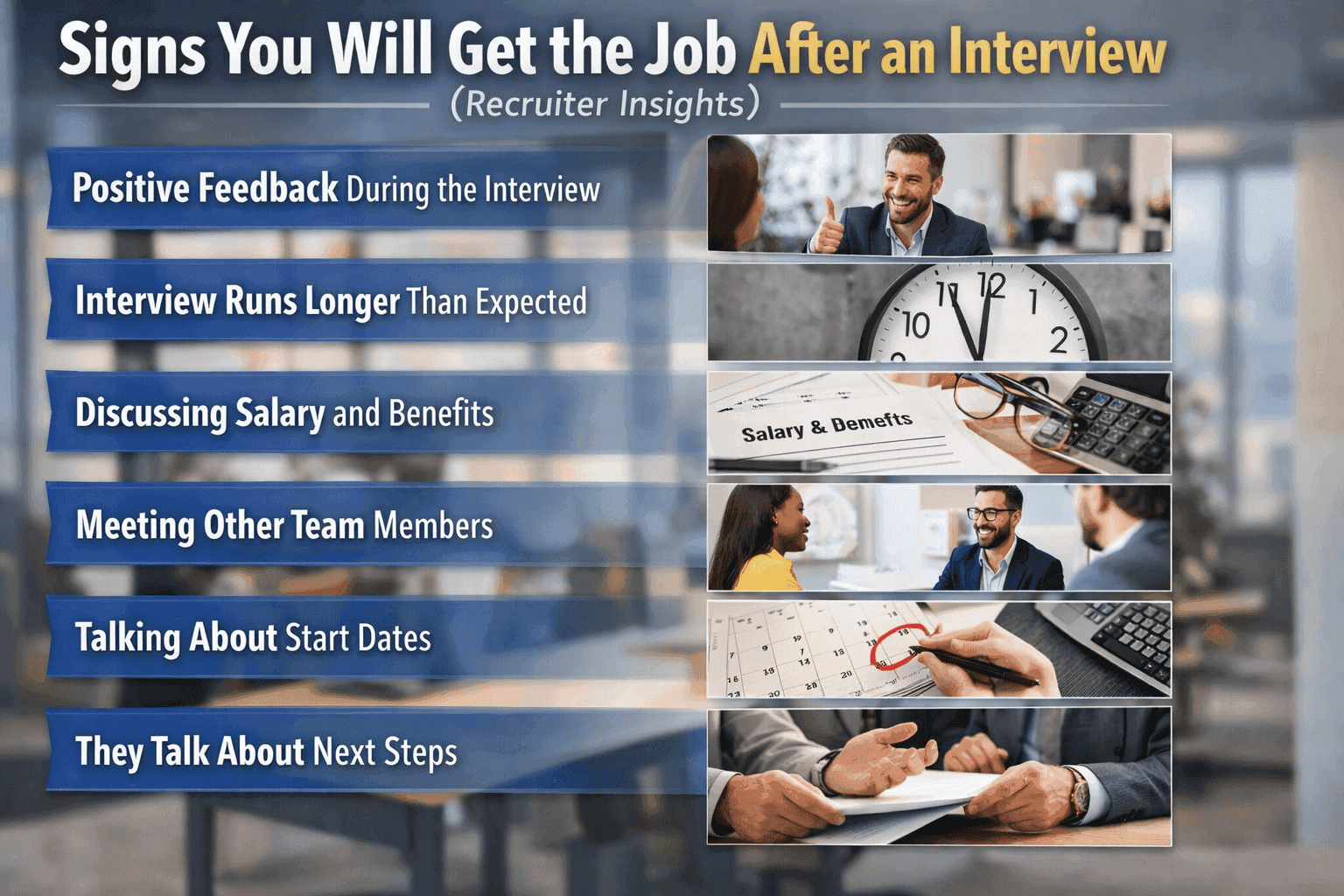
Signs You Will Get the Job After an Interview (Recruiter Insights)
Learn the most reliable signs you will get the job after an interview and how to understand recruiter signals.
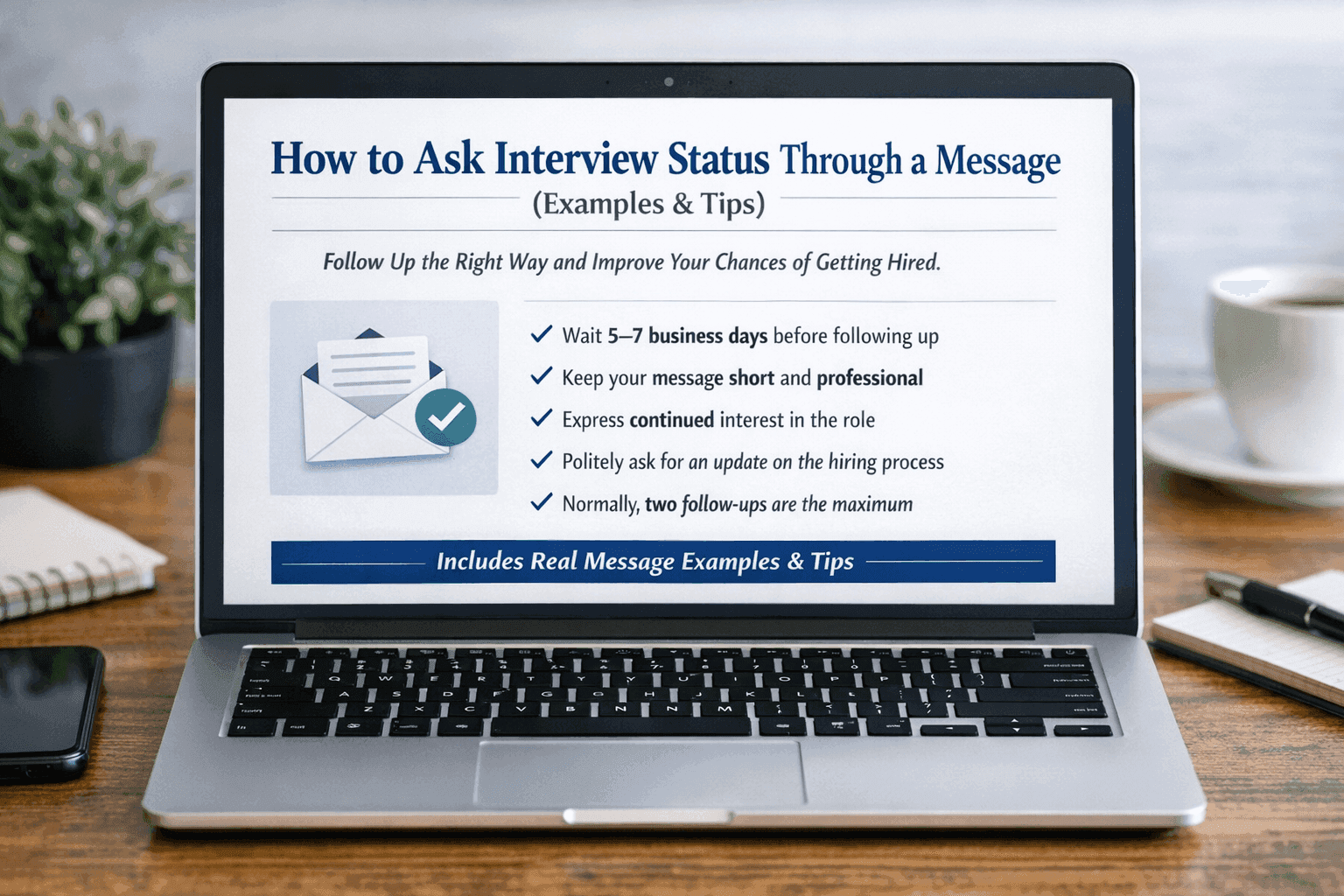
How to Ask Interview Status Through a Message (Examples & Tips)
Learn how to ask about interview status politely with professional follow-up messages, timing tips, and real examples to improve hiring chances.