How to List Publications on a Resume (Examples & Format Guide)
Listing publications on your resume proves expertise, research ability, and thought leadership through recognized academic, professional, or online work.
Overview
Adding a Publications section to your resume highlights your expertise, research skills, and professional credibility. It shows employers that your knowledge is recognized through published work such as journals, articles, blogs, or case studies. Well-formatted publications strengthen your profile, demonstrate thought leadership, and help you stand out in competitive academic and professional roles.
If you’ve written research papers, journal articles, case studies, blog posts, or any form of published work, showcasing them on your resume can instantly elevate your professional profile. Adding a Publications section highlights you as someone with verified expertise, strong communication skills, and recognized contributions to your field. It signals to employers, recruiters, and academic institutions that you are not only knowledgeable, but also willing to share insights, conduct research, and influence others through your writing.
Whether you are a student with university publications, a researcher with peer-reviewed journals, a professional featured in industry magazines, or a writer with online articles, listing your publications demonstrates thought leadership, credibility, and subject-matter authority. It differentiates you from other candidates with similar qualifications and can be a deciding factor in competitive applications.
In this guide, you’ll learn the right way to present your published work on a resume. We’ll cover where to place your publications, the formatting styles to use, and examples tailored for academic, professional, and online platforms. By the end, you’ll know exactly how to display your publications in a clear, polished, and impressive manner that strengthens your resume and supports your career goals.
Key Points
Demonstrates verified expertise and subject-matter authority
Highlights strong research, writing, and analytical skills
Adds credibility through peer-reviewed or recognized platforms
Strengthens applications for academic, research, and professional roles
Differentiates you from candidates with similar qualifications
Supports career growth, scholarships, and competitive opportunities
Why Should You List Publications on a Resume?
Including a Publications section on your resume can significantly elevate your professional profile and set you apart from other candidates. Publications demonstrate that your work, ideas, and insights have been recognized, approved, and valued by external sources whether academic institutions, industry platforms, or reputable online media. This shows employers that you possess in-depth knowledge in your field and are capable of producing high-quality written work backed by research, expertise, and clarity of thought.
Listing your publications also highlights key strengths such as strong writing skills, research abilities, critical thinking, and subject-matter authority. It positions you as a contributor rather than just a participant, reflecting your ability to add value to academic, scientific, corporate, or creative environments. For employers, this signals that you can support projects, produce well-researched content, and represent the organization with credibility.
Publications are especially impactful for careers in education, research, journalism, writing, healthcare, marketing, science, and technology, where thought leadership matters. By showcasing your published work, you prove that your expertise is not just theoretical, it has been shared, acknowledged, and trusted by others. This instantly strengthens your resume, enhances your professional reputation, and improves your chances of landing interviews, scholarships, or career-advancing opportunities.
Also Read : First Job Resume Examples with Samples & Writing Tips
When Should You Include Publications on a Resume?
Include publications if:
- You are applying for research or academic roles
- You have work published in journals, magazines, or websites
- Your writing supports your professional expertise
- You want to show industry credibility and authority
You can skip this section if your work is unpublished or unrelated to your field.
Also Read : ATS Full Form in Resume: Resume Guide with Examples (2026)
Where to List Publications on a Resume
You can place publications in different sections depending on their importance:
1. Dedicated “Publications” Section (Best for academics and professionals)
Place this below your Education or Work Experience.
2. Under “Research Experience” or “Academic Achievements”
Ideal for students, researchers, and lecturers.
3. Under “Projects” or “Portfolio”
Suitable for online writers, bloggers, marketers, and creatives.
4. Within “LinkedIn / Portfolio Link” Section
If you have many publications, link to your Google Scholar, ORCID, Medium, or personal website.
Also Read : How to Write a Resume with Project Details (Examples & Tips)
How to Format Publications on a Resume
Your format depends on the type of publication and the field you work in. Below are the most accepted styles.
Academic Publication Formats
Academic resumes use formal citation styles.
APA Format (Common in Education, Psychology, Social Sciences)
Format:
Last name, Initials. (Year). Title of article. Journal Name, Volume(Issue), Page range.
Example:
Ahmed, R. (2023). The impact of AI on student learning. Journal of Modern Education, 14(2), 45–57.
MLA Format (Common in Humanities & Literature)
Format:
Last name, First name. “Title of Article.” Journal Name, vol. ##, no. ##, Year, pages.
Example:
Singh, Priya. “Cultural Influences in Children’s Literature.” Creative Writing Review, vol. 9, no. 1, 2024, pp. 22–29.
Chicago Style (Used for history & publishing)
Format:
Last name, First name. “Article Title.” Journal Name Volume, no. Issue (Year): Pages.
Example:
Hussain, Omar. “Revisiting Mughal Architecture.” South Asian Historical Journal 11, no. 3 (2022): 87–104.
IEEE Format (Used in Engineering, IT & Tech)
Format:
Initials. Last name, “Title,” Journal Name, vol. #, no. #, pp. #–#, Year.
Example:
S. Khan, “Blockchain Security Enhancements,” Tech Innovations Journal, vol. 18, no. 4, pp. 101–110, 2023.
Professional Publication Format
Used for business, marketing, healthcare, law, finance, and industry-based publications.
Format:
Author. “Title of Publication.” Publisher/Platform, Year.
Example:
Ali, Sara. “Customer Retention Strategies for E-commerce Brands.” Harvard Business Review, 2024.
Online Publication Format
If your work is online (blog, magazine, website), add a link.
Format:
Author. “Title of Article.” Website/Platform, Year. URL.
Example:
Raza, Hamid. “5 Freelancing Trends to Watch in 2025.” Medium, 2025. https://medium.com/5-freelancing-trends.
Also Read : SEO Executive Resume Templates & Tips for Every Experience Level (ATS Guide)
Mixed Examples Based on Resume Types
Student or Fresh Graduate Resume Example
Publications
• Khan, A. (2024). “Solar Energy Awareness Among Students.” University Research Journal, 5(1), 15–21.
• “How Students Can Manage Stress During Exams.” University Magazine, 2023.
Academic or Research Resume Example
Publications
• Malik, H. (2023). “AI Ethics in Health Data.” International Journal of Medical Research, 12(3), 99–105.
• Malik, H., & Zhou, L. (2024). “Ethical Algorithms for Clinical Diagnosis.” Health Informatics Conference Proceedings 2024.
Professional Resume Example
Publications
• “Top Business Expansion Strategies for 2025.” Forbes, 2024.
• Hussain, M. (2023). “How AI is Reshaping Digital Marketing.” TechWorld Magazine.
Online Writer or Content Creator Resume Example
Publications
• “10 Resume Mistakes That Cost You Interviews.” SoundCV Blog, 2025.
• “How to Build a Personal Brand on LinkedIn.” Medium, 2024. https://medium.com/personal-branding-guide
Also Read : How to Add Certifications in Resume: Complete Guide with Examples
How to List Multiple Publications
If you have many publications, use sub-categories:
- Publications
- Peer-Reviewed Journals
- Books & Book Chapters
- Conference Papers
- Online Articles & Blogs
This makes your resume clean and easy to read.
Tips for Listing Publications on a Resume
- List publications in reverse chronological order (most recent first)
- Use one consistent citation style throughout
- Include links to online publications
- Only list relevant or credible publications
- Keep the section concise avoid long paragraphs
- For unpublished work, use a “Work in Progress” or “Manuscripts” section
Common Mistakes to Avoid
- Mixing citation styles (APA + MLA in one resume)
- Including unpublished papers without stating their status
- Listing irrelevant or low-quality publications
- Adding too many links that clutter the resume
- Not updating publications as new work gets published
Final Thoughts
Listing your publications on a resume is one of the most powerful ways to showcase your expertise, credibility, and contribution to your field. Whether your work has appeared in academic journals, professional industry platforms, or reputable online sites, it highlights your knowledge and positions you as a thought leader. Knowing how to list publications on a resume correctly ensures your achievements are presented in a polished, professional, and impactful manner.
The key is to choose the right placement, use a consistent citation style, and list only relevant publications that support your career goals. Academic applicants may require structured formats like APA, MLA, Chicago, or IEEE, while professionals and online writers can use a simpler, reader-friendly format. By tailoring your publication section to your target role whether in education, research, business, or creative industries you make your resume more compelling to hiring managers.
Remember, your resume is a marketing tool. Featuring your publications strategically not only strengthens your profile but also sets you apart from other candidates with similar qualifications. Keep your list updated, concise, and well-organized. When done right, your publications can significantly boost your chances of securing interviews, research roles, academic positions, or industry-based opportunities.
FAQs
Frequently asked questions about this topic
Related Blogs
Explore more insights and guides you might like.
How to List References on a Resume in 2026
Learn the modern 2026 approach to listing references on your resume for maximum professionalism and recruiter impact.
Is Sound CV good for students and fresh graduates with no experience?
Sound CV is perfect for students and fresh graduates, helping them create professional resumes that highlight skills, projects, and potential even with little or no work experience.
Why Sound CV Is Different from Other AI Resume Builders
Sound CV stands out by creating job-focused, ATS-friendly resumes that highlight real achievements, not just generic content.
Resume Format for HR Job: Professional Guide and Sample Templates
A complete guide to the best resume format for HR jobs, with expert tips and sample templates to help you create a professional and job-ready resume.
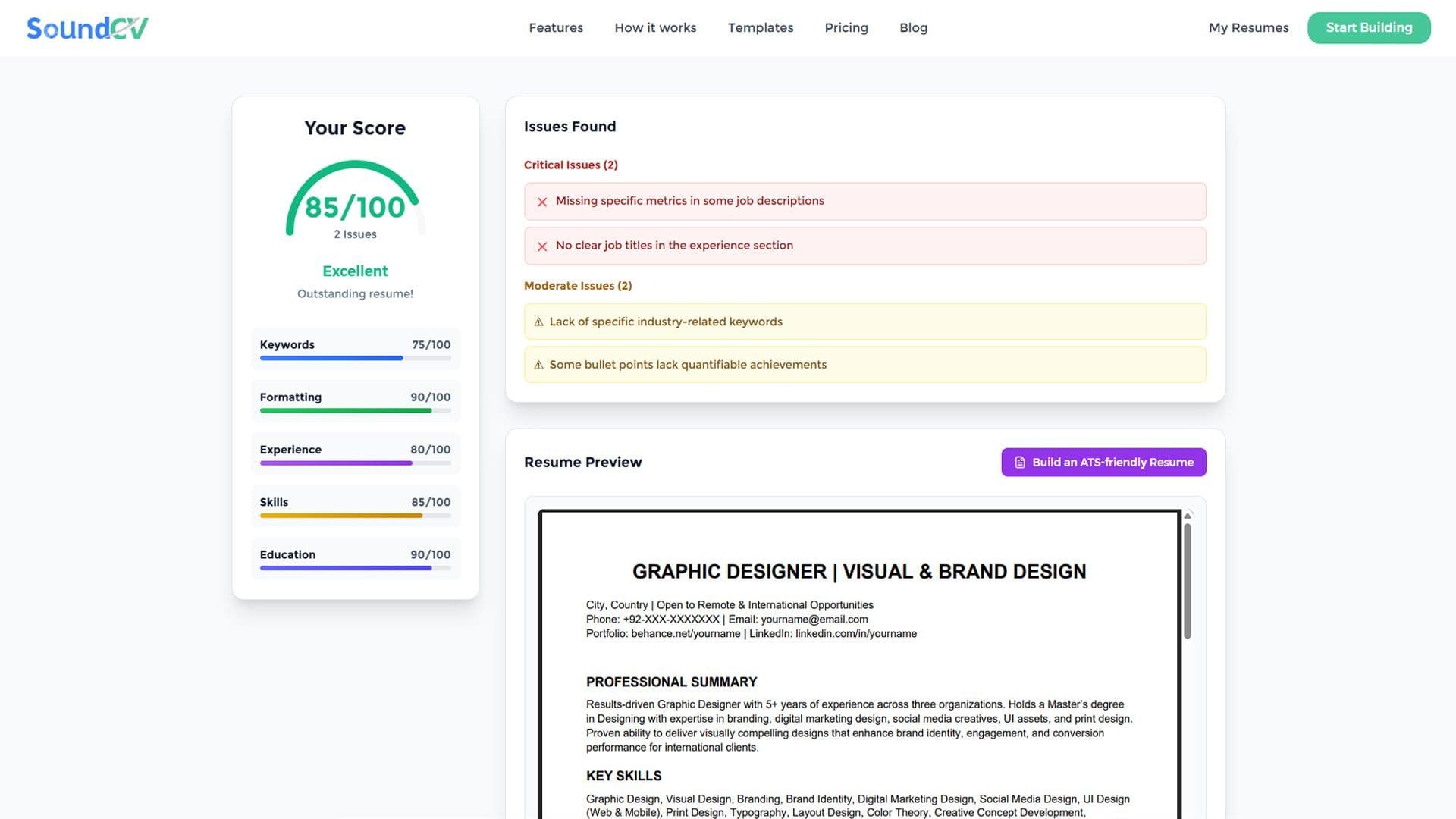
How Does the Sound CV Resume Score Checker Work?
The Sound CV Resume Score Checker analyzes your resume against ATS requirements, job-specific keywords, and structure to provide an instant, actionable score.
What Is a Sound CV? Features, Benefits, and How It Works
A Sound CV is an AI-powered resume that is tailored, ATS-optimized, and designed to showcase your skills and achievements to help you stand out to recruiters.