Activities for Resume: Best Examples and How to List Them (2026)
A simple 2026 guide to the best resume activities with clear examples to help you stand out.
Overview
Adding the right activities to your resume can show who you are beyond grades and job titles. They highlight teamwork, leadership, problem-solving, and real-world involvement perfect for students, fresh graduates, and professionals. This guide explains which activities to include, the difference between co-curricular and extracurricular work, and gives simple examples you can use in your 2026 resume.
Activities for resume are one of the most overlooked sections in any job application. Most candidates focus only on work experience, education, and skills, but skip the one section that actually shows who they are beyond their qualifications. Your activities section is where personality, leadership, initiative, and passion come through. For students and fresh graduates with little work history, the right extracurricular activities for resume can be the difference between getting shortlisted and getting ignored. For experienced professionals, well-chosen activities signal depth of character and transferable skills that no job title can fully capture.
In this guide, you will find exactly which activities to put on a resume, how to list them with real examples by career path, where to place them, and how to describe them so recruiters take notice. Whether you call it activities for resume or activities for CV, the rules are the same. This guide covers everything from choosing the right entries to formatting them for 2026.
Why Activities Matter on Your Resume
Recruiters do not just hire qualifications. They hire people. Your activities section tells them what you do when you are not required to do anything, and that reveals more about your character than most work experience entries ever will.
Research consistently shows that hiring managers at top firms consider extracurricular involvement during screening, especially for entry-level roles. Here is what the right activities signal to an employer:
- Leadership: You can organize, motivate others, and take responsibility.
- Teamwork: You know how to collaborate toward a shared goal.
- Time management: You balance multiple commitments without dropping the ball.
- Initiative: You do not wait to be told what to do.
- Communication: You can engage, persuade, and present in real-world settings.
For early-career candidates, activities fill the experience gap. For experienced professionals, they show you are a well-rounded person and not just someone who clocks in and out. The activities section on resume real estate is small, so every entry needs to count.
One thing to keep in mind: not every activity carries equal weight. A student who led a 12-person club and grew its membership by 40% has a stronger resume entry than one who just attended meetings. The key is framing, which this guide covers in full.
What Counts as an Activity for Your Resume?
Before you start listing things, it helps to know what qualifies as an activity worth including. In resume terms, any structured involvement that required your time, produced a result, or developed a skill can count. This includes:
- Club memberships and leadership roles
- Volunteer work and community service
- Sports teams and athletic competitions
- Academic competitions, case studies, and hackathons
- Side projects, freelance work, and entrepreneurial ventures
- Creative pursuits like theater, music, and art exhibitions
- Cultural or social organizations
- Student government or council positions
What does not count: passive memberships where you did nothing, or hobbies with no demonstrated skill or result. If you cannot describe what you did or name a result it produced, it probably does not belong on your resume.
Co-Curricular vs Extracurricular Activities for Resume
One of the most common questions candidates ask is about the difference between co-curricular and extracurricular activities, and which type to list. Both belong on a resume, but they tell different stories to recruiters.
Co-Curricular Activities
Co-curricular activities are directly connected to your academic program. They complement what you learn in class and apply it in a practical setting.
Examples include:
- Science fair or academic competition
- Business case study competition
- Research project supervised by a faculty member
- University-organized workshop or conference
- Debate team linked to a coursework module
These activities show academic initiative and the ability to apply knowledge beyond the classroom. They are particularly strong for roles that value intellectual rigor, like consulting, research, or engineering.
Extracurricular Activities
Extracurricular activities happen outside formal academics and are driven by personal choice rather than academic requirements. They reveal personality, passion, and self-direction.
Examples include:
- Volunteering at an NGO or community center
- Playing on a sports team
- Joining a drama, music, or photography club
- Running a student organization
- Leading a fundraiser or social campaign
Extracurricular activities are valued for the soft skills and real-world impact they demonstrate. If you managed a team, raised funds, or built something from scratch outside of class, that is worth including on your resume.
The bottom line: both types add value. Co-curricular activities reinforce your academic strength. Extracurricular activities show who you are as a person. A strong resume typically includes both. At competitive companies, extra curricular activities in cv applications carry as much weight as your GPA or degree name, and sometimes more. For a deeper look at how to present these on a CV, read our guide on extracurricular activities in CV.
Best Activities for Resume by Career Path
Not every activity impresses every employer. A hiring manager in tech cares about different things than one in healthcare or marketing. The best activities for resume are the ones that align with the skills your target industry actually values.
Here is a breakdown by career path with specific activity examples and the skills each one signals.
Tech and Engineering Roles
For software engineering, data science, and technical roles, activities that show problem-solving and hands-on building carry the most weight with recruiters.
- Coding bootcamps or hackathons: Show rapid prototyping, collaboration under pressure, and technical depth.
- Open-source contributions: Demonstrate initiative and real-world coding ability beyond coursework.
- Robotics club or engineering society: Signals applied technical thinking and teamwork.
- Personal projects (apps, websites, tools): Show you build things because you love it, not just because you are told to.
- Cybersecurity competitions (CTF): A strong signal for security and systems roles.
Sample entry:
Participant, National Hackathon (HackFest 2024)
Built a real-time logistics tracking app in 24 hours using Python and React. Placed 3rd out of 80 teams.
Business, Finance, and Consulting Roles
Employers in these fields look for structured thinking, communication, and the ability to handle pressure. Activities that mirror real business environments stand out most.
- Business case competitions: Directly simulate consulting and strategy work.
- Entrepreneurship projects: Running a small business shows initiative and commercial thinking.
- Debate team or Model UN: Develops argumentation, research, and public speaking.
- Finance or investment clubs: Shows proactive learning beyond the curriculum.
- Fundraising or event coordination: Demonstrates budget management and logistics skills.
Sample entry:
Vice President, Finance Society (2023-2024)
Organized 4 investment workshops attended by 200 students. Managed an $800 annual event budget with zero overspend.
Marketing and Creative Roles
Creative candidates need activities that show execution, not just ideas. Employers want evidence that you can produce real work and deliver results.
- Student magazine or campus publication: Writing, editing, and publishing experience combined.
- Social media content creation: Especially valuable if you grew a page or ran campaigns with measurable reach.
- Photography or videography club: Strong for digital marketing and content roles.
- Graphic design projects: Personal branding, poster design, or UI mockups show applied skill.
- Theater or performing arts: Builds communication, stage presence, and audience awareness.
Sample entry:
Editor, Campus Magazine (2022-2023)
Led a 7-person team to produce a monthly digital publication. Grew readership from 400 to 1,200 subscribers in 8 months.
Healthcare and Life Sciences
Healthcare employers value empathy, responsibility, and community awareness. Volunteer work and mentoring roles carry the most weight in this field.
- Hospital or clinic volunteering: Patient interaction and real healthcare exposure.
- Peer tutoring or mentoring programs: Shows patience, communication, and commitment to others' growth.
- Community health campaigns: Signals social responsibility and organizational skills.
- Medical or science Olympiads: Demonstrates subject mastery under competitive pressure.
Sample entry:
Volunteer, Community Health Outreach Program (Summer 2023)
Assisted in patient registration and guided 80 daily visitors. Supported 12 health education sessions for rural communities.
Education and Nonprofit Roles
Passion for impact matters most in these fields. Activities that demonstrate service, communication, and youth engagement align directly with what employers look for.
- Tutoring or teaching assistant roles
- Community literacy or adult education programs
- NGO volunteering or project coordination
- Student council leadership positions
- Environmental or social activism campaigns
Extracurricular Activities for Resume Examples by Situation
Seeing a well-formatted activities on resume sample is the fastest way to understand what works. Here are three complete examples covering different candidate situations.
Example 1: Student Resume (No Work Experience)
Activities and Involvement
- President, Debate Society (2023-2024)
Organized 6 inter-school tournaments and coached 10 team members. Led the team to regional finals for the first time in 4 years. - Volunteer, Edhi Foundation (Ramadan 2024)
Coordinated food distribution for 300 families. Managed 15 volunteers across two daily shifts. - Member, Photography Club (2022-2024)
Contributed visual content to school magazine. Awarded Best Photo of the Year 2023 by school committee.
Example 2: Graduate Applying for a Corporate Role
Co-Curricular Activities
- 2nd Place, University Business Case Competition 2023
Presented a market-entry strategy for an e-commerce startup to a panel of 5 industry judges. Competed against 50 teams from 12 universities. - Research Assistant, Marketing Department (2023)
Analyzed consumer behavior patterns using SPSS. Co-authored a report presented at the department's annual research forum.
Extracurricular Activities
- Captain, University Football Team (2022-2023)
Led a 14-player squad to inter-city semifinals. Coordinated weekly training schedules and resolved team conflicts under tournament pressure.
Example 3: Professional Updating Their Resume
Volunteer Experience
- Board Member, Tech for Girls NGO (2022 to Present)
Oversee curriculum development for a coding program serving 120 students aged 14-18. Secured 2 corporate sponsorships totaling $3,500.
These activities in a resume examples show the before/after impact of specific, quantified descriptions. For more ideas on framing results-focused entries, read our guide on achievements in a resume because the same rules of specificity and impact apply.
Where to Put the Activities Section of Resume
Placement depends on your experience level and how relevant the activity is to the role you are targeting.
Option 1: Dedicated Activities Section
This is the best choice for students, fresh graduates, and anyone with two or fewer years of formal work experience. Title the section one of the following:
- Activities and Involvement
- Extracurricular Activities
- Leadership and Community Involvement
- Involvement Section
Place it after your education section and before or after skills. If you have three or more strong activities, a dedicated involvement section is worth the space.
Option 2: Inside the Education Section
If your activities are directly tied to your studies, list them as bullet points under your degree. This works well for co-curricular activities like academic competitions, research projects, and society leadership roles at your university.
Example:
Bachelor of Computer Science, FAST-NUCES Lahore (2021-2025)
- Lead Developer, Final Year Project: IoT-based smart home system using Arduino and Python
- President, ACM Student Chapter (2023-2024)
Option 3: As a Standalone Volunteer Experience Section
Many recruiters specifically scan for volunteer work. If your volunteer involvement is extensive, give it its own section so it does not get buried inside a general activities list. If the volunteer role required 15 or more hours per week and produced significant results, it can even go under Work Experience.
Volunteer Work Examples for Resume
Volunteer work is one of the most transferable and respected categories of resume activities. It signals empathy, reliability, and commitment to something bigger than yourself. These qualities matter to almost every employer, regardless of industry.
When listing volunteer work examples for resume, use the same structure as paid work: role title, organization, dates, and two to three bullet points with action verbs and measurable results.
Strong Volunteer Resume Examples
Community Coordinator, Green Pakistan Initiative (2023-Present)
- Organized 8 neighborhood cleanup drives with 50 volunteers per event.
- Raised $250 in event funding through local business outreach.
Tutor, Teach for Pakistan (2022-2023)
- Taught English and math to 25 underprivileged students aged 10-14.
- Improved average test scores by 35% over 6 months of weekly sessions.
Social Media Volunteer, WWF Pakistan (Summer 2023)
- Created content for a climate awareness campaign that reached 15,000 people.
- Designed 12 graphics and wrote captions for Instagram and Facebook posts.
Notice how each entry uses an action verb, states what was done, and includes a number. This format passes ATS scanning and reads well to human recruiters at the same time.
Hobbies and Interests in Resume: What Is the Difference?
Many candidates confuse activities with hobbies and interests in resume sections. They are related but serve different purposes.
Activities are structured, goal-oriented, and usually results-driven. You had a role, committed time, and produced something, whether that was an event, a result, or a team outcome. Hobbies and interests are personal and informal. They reveal personality and cultural fit but carry less evidence value unless they directly relate to the job or involve a verifiable result.
For example:
- "Photography" as a hobby: generic and low value on its own.
- "Photography Club Member: contributed to school yearbook and won campus photo contest 2024": specific, with a result, and a much stronger entry.
Include hobbies when they reinforce your personal brand, are directly relevant to the role, or open natural conversation in an interview. One strong activity entry beats five passive hobby lines every time. Listing hobbies in resume sections only makes sense when they demonstrate a relevant skill or add a dimension that work experience cannot. For a full breakdown of which interests to include, see our guide on hobbies for resume.
Activities and Interests to Put on a Resume: What to Avoid
Choosing the right activities and interests for resume sections is just as important as choosing what to leave out. Not every activity helps your application. Some entries waste valuable space, some send the wrong signal, and some simply do not add value. Here is what to leave off your resume:
- Activities with no demonstrated skill or result: "Member, Book Club (2022)" tells a recruiter nothing about what you did or what you gained from the experience.
- Politically divisive affiliations: Partisan political organizations can alienate employers before you even reach the interview stage.
- Activities from more than 10 years ago: Unless the achievement is exceptional (national title, published work), older entries add clutter and take space away from more recent and relevant experience.
- Passive hobbies with no professional translation: Watching sports, playing video games, or similar activities only work if you have a result to show, such as building a game, running a gaming channel, or competing at a recognized level.
- Activities that contradict the role: Listing extreme sports on a risk-averse financial services application, or hunting on an animal welfare job, sends the wrong signal regardless of how proud you are of the activity.
- Vague memberships: "Member" with no description of your contribution is filler. If you just attended meetings, leave it off entirely.
The rule is simple: if the activity does not demonstrate a skill, show a result, or add useful context to your candidacy, it does not belong on your resume.
How to List Activities on Resume Using Action Verbs
Generic descriptions kill strong activities. The fix is one technique: lead every bullet point with a strong action verb, then tie it to an outcome. This approach works for every activity type and every career level.
Here are 30 action verbs organized by the skill they signal:
| Skill Signal | Action Verbs |
|---|---|
| Leadership | Led, Directed, Managed, Coordinated, Founded, Supervised |
| Communication | Presented, Negotiated, Facilitated, Pitched, Wrote, Edited |
| Organization | Organized, Planned, Scheduled, Budgeted, Executed, Launched |
| Impact | Raised, Grew, Improved, Reduced, Achieved, Won |
| Collaboration | Collaborated, Mentored, Trained, Partnered, Supported, Contributed |
Pair each verb with a number wherever possible. "Organized an event" is weak. "Organized an annual charity gala for 300 attendees and raised $1,200 for a local school" is strong. Numbers are what ATS systems pick up and what recruiters remember when they put the resume down.
When building your resume, use SoundCV's AI resume builder to structure your activities section properly and align it with the job description keywords automatically.
Activities for Resume for Students with No Work Experience
If you are a fresh graduate or still in school, your activities section is not a nice-to-have addition. It is your primary evidence that you can take responsibility and deliver results. Here is how to make it work.
Prioritize Leadership Over Participation
Being president of a small club beats being a member of a large and famous one. Leadership roles show you were trusted with real responsibility, and that is what employers want to see from a candidate with no paid work history.
Quantify Everything You Can
Even small numbers tell a story and show you think in results-oriented terms:
- "Managed a team of 4" is stronger than "worked in a team."
- "Grew Instagram page from 200 to 900 followers" is stronger than "ran social media."
- "Tutored 8 students over 3 months" is stronger than "peer tutoring."
Include Academic Projects
Final year projects, research papers, and academic competitions count as activities when they demonstrate real skills. Do not leave them buried inside your degree entry. Give them their own line with an action verb and a result.
Count Side Projects as Activities
Built an app? Ran a YouTube channel? Worked as a freelance designer or writer? These are activities. Many employers rate self-initiated projects more highly than club memberships because they show intrinsic motivation and real output without any institutional structure pushing you forward.
Students often ask whether their resume is competitive enough. Use SoundCV's free resume score checker to see exactly how your activities section scores against ATS standards and what gaps are still there.
For more targeted advice on how to structure a full student resume, read our guide on skills for resume, which covers how activities and skills work together to build a complete profile.
How ATS Systems Read Your Activities Section
Most mid-to-large employers use Applicant Tracking Systems to screen resumes before a human ever reads them. Your activities section is scanned just like every other section. Here is what that means in practice:
- Section title matters: Use standard headers like "Activities," "Extracurricular Activities," "Volunteer Work," or "Leadership and Involvement." Unusual titles may not be parsed correctly by ATS software.
- Keywords count: If the job description mentions leadership, teamwork, or community involvement, use those exact words in your activity descriptions. Student organizations, volunteer roles, and sports teams all carry relevant keywords.
- Clean formatting is required: No tables, text boxes, or columns. ATS systems read linear text. Use an ATS-friendly layout: plain single-column, no graphics. If your resume uses a fancy template with multiple columns, the activities section may be misread or skipped entirely.
- Dates and organization names matter: Include both. ATS systems use dates to establish timelines and organization names to verify the legitimacy of the entry.
If you are not sure whether your resume is ATS-ready, check your resume score on SoundCV. The tool flags formatting problems, missing keywords, and section structure issues in under 30 seconds.
Frequently Asked Questions About Activities for Resume
What are good hobbies to put on a resume?
Good hobbies for resume sections are ones tied to a real skill or a specific result. Photography works if you have a portfolio or award. Writing works if you have a blog or published piece. Coding works if you have a project to show. Sports work if you held a leadership role or competitive placing. Vague hobbies like reading or travelling are too generic unless tied to a specific achievement relevant to the role.
What activities should I put on my resume as a college student?
College students should prioritize leadership roles, academic competitions, volunteer work, and any club or organization where they held responsibility or produced a measurable result. The strongest entries include a title, organization name, dates, and at least one quantified outcome. If you have no formal leadership role, include projects, research, or part-time involvement that demonstrates initiative and skills relevant to your target career path.
What are the best hobbies for resume sections in 2026?
The best hobbies for resume sections in 2026 are ones aligned with in-demand workplace skills: content creation, coding projects, public speaking (debate or Toastmasters), community service, and entrepreneurship. These signal initiative, digital fluency, and communication ability. Hobbies that show you operate at a competitive level, whether athletic, academic, or creative, are also strong. Any hobby that produced a measurable result, grew an audience, or earned recognition is worth including.
How many activities should I list on my resume?
List two to four activities at most. Quality matters far more than quantity. Three well-described activities with clear outcomes leave a stronger impression than seven vague entries. If you have extensive involvement, pick the ones most relevant to the role and the ones where you can provide the most detail. Recruiters spend an average of 7 seconds on an initial resume scan, so concise and impactful entries are what get noticed, not long lists with thin descriptions.
Where should I put the activities section on my resume?
For students and fresh graduates, place the activities section directly after your education. For professionals with three or more years of experience, place it near the bottom after work experience and skills. If your volunteer work is highly relevant to the role, give it its own section and position it higher. Never bury a strong activity at the bottom of a long resume where most recruiters will not reach it.
What activities should a fresher include in their resume?
Freshers should include any structured involvement where they held a role, contributed to a team, or produced a result. The best options are club or society leadership, academic competitions, research or final-year projects, volunteering, sports captaincy, and any freelance or self-initiated work. Even a consistent tutoring arrangement or a personal app project counts. The goal is to show you have been active, responsible, and results-oriented before entering the workforce formally.
What activities and honors should I list on my resume?
Activities and honors on resume sections work well together when you have both to show. For activities, include the role, organization, dates, and one to two bullet points with results. For honors, list the award name, granting body, and year. Here is an activities and honors resume example: President, Science Society (2023-2024), led team to 1st place at the National Science Olympiad. Pair them only when both are relevant to the role.
Can I include fun resume activities for students on a resume?
Yes, fun resume activities for students are fine as long as they demonstrate a skill or result. A gaming club counts if you organized tournaments for 60 players: that is event management. A film club counts if you directed a short film that screened at a campus festival: that is creative direction. What matters is whether you can describe what you did, what skills it built, and what the outcome was.
How do I write the activities section of my resume for writing jobs?
For writing jobs, your activities section should feature any editorial, publishing, or blogging involvement. Lead with roles where you produced written content that reached an audience: newspaper editor, blog author, or newsletter writer. Include the publication name, your role, and a measurable result such as readership numbers or articles written. For writing roles specifically, this section functions almost like a mini portfolio, so be specific about what you wrote and where it appeared.
What activities and interests should I put on my resume to impress employers?
To impress employers, choose activities and interests that match the core skills the role requires and show real results. Leadership roles impress management-track employers. Technical projects impress tech employers. Community service impresses nonprofits. Creative output impresses agencies. The most impressive entries are specific, quantified, and directly relevant to what the employer is hiring for. A single well-chosen activity with a strong result always beats a long list of vague involvements.
Once your activities section is polished, run your resume through SoundCV's free resume score checker to confirm it meets ATS requirements and presents your full profile as effectively as possible.
Related Blogs
Explore more insights and guides you might like.
How to List References on a Resume in 2026
Learn the modern 2026 approach to listing references on your resume for maximum professionalism and recruiter impact.

Is Sound CV good for students and fresh graduates with no experience?
Sound CV is perfect for students and fresh graduates, helping them create professional resumes that highlight skills, projects, and potential even with little or no work experience.
Why Sound CV Is Different from Other AI Resume Builders
Sound CV stands out by creating job-focused, ATS-friendly resumes that highlight real achievements, not just generic content.

Resume Format for HR Job: Professional Guide and Sample Templates
A complete guide to the best resume format for HR jobs, with expert tips and sample templates to help you create a professional and job-ready resume.
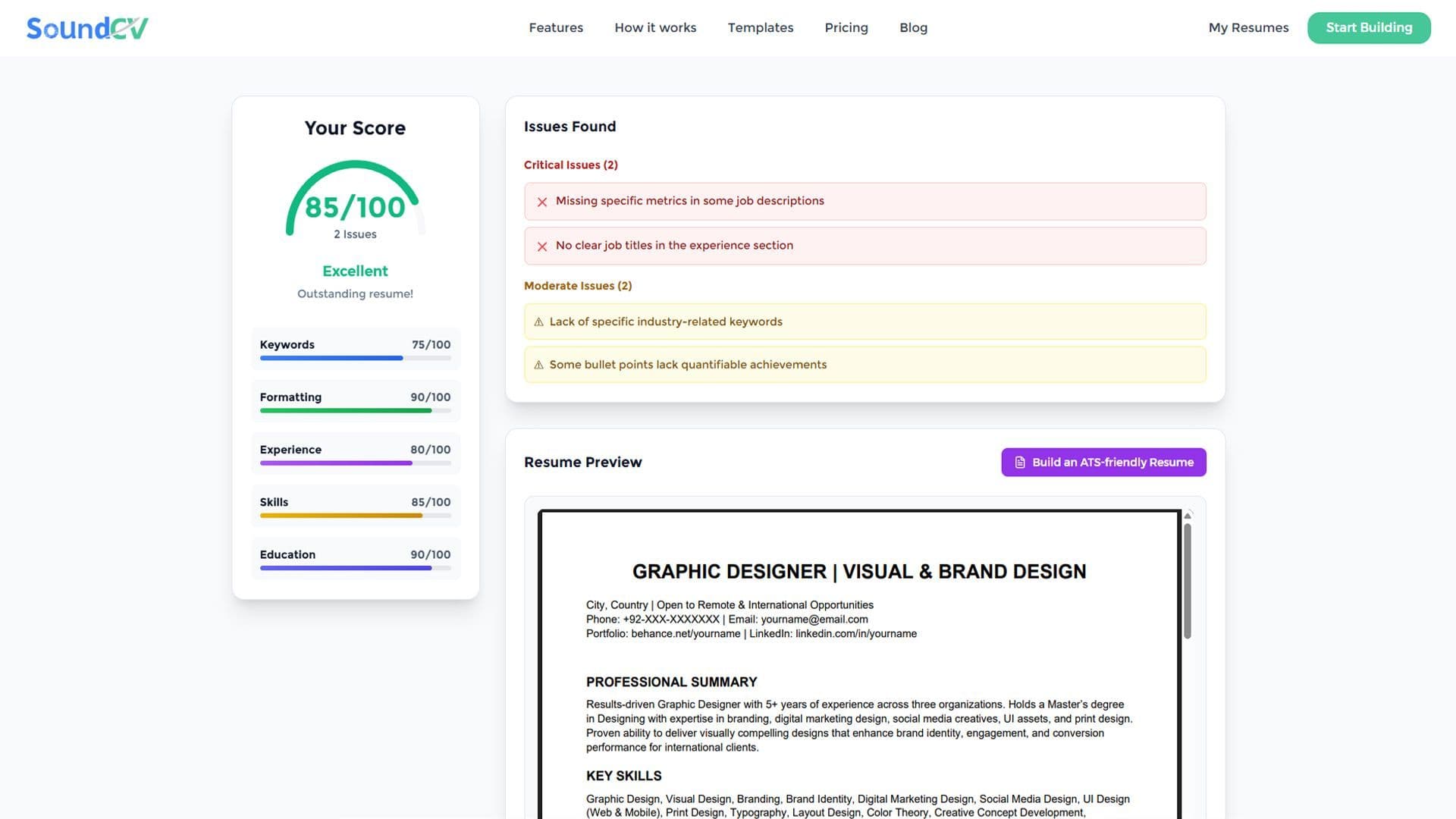
How Does the Sound CV Resume Score Checker Work?
The Sound CV Resume Score Checker analyzes your resume against ATS requirements, job-specific keywords, and structure to provide an instant, actionable score.
What Is a Sound CV? Features, Benefits, and How It Works
A Sound CV is an AI-powered resume that is tailored, ATS-optimized, and designed to showcase your skills and achievements to help you stand out to recruiters.