Teacher Interview Questions and Answers: Best Guide to Get Hired
Prepare for teaching interviews with common questions, sample answers, and proven strategies to confidently impress hiring committees and get hired.
Overview
Explore the most important teacher interview questions and answers, including STAR method examples, classroom management strategies, and expert tips to help you stand out, build confidence, and successfully secure your dream teaching job in competitive school hiring processes.
You've polished your resume, submitted your application, and now the email arrives: you've landed an interview. What happens next will determine whether you walk into a classroom of your own or keep searching. With 74% of school districts reporting difficulty filling open positions in the 2024–25 school year and over 400,000 teaching roles either vacant or filled by underqualified educators nationally, schools are actively looking for strong candidates. The opportunity is real. But so is the competition.
The difference between candidates who get offers and those who don't often comes down to interview preparation. Principals and hiring committees aren't looking for rehearsed perfection; they want authentic educators who can articulate their teaching philosophy, demonstrate classroom management skills, and show genuine passion for students. This guide breaks down the most common teacher interview questions and answers, gives you practical sample responses you can adapt, and shares proven strategies to help you walk in confident and walk out hired.
Key Points
- Covers most common teacher interview questions
- Includes real sample answers for better understanding
- Explains STAR method with practical examples
- Focuses on classroom management strategies
- Helps improve interview confidence
- Provides tips to impress hiring committees
- Suitable for freshers and experienced teachers
The Questions Every Teaching Candidate Should Prepare For
Certain teacher job interview questions appear in virtually every hiring conversation, regardless of grade level or subject area. Mastering these common teacher interview questions gives you a foundation to handle nearly anything a panel throws at you.
"Why do you want to be a teacher?"
This is the single most frequently asked question in teaching interviews. Hiring managers want a specific, personal story, not a generic 'I love kids.' Connect your answer to a real experience that shaped your calling.
Sample Answer
"My 4th-grade teacher, Mrs. Paulette, changed my life. I struggled with reading, and she introduced our class to stories that switched on an unquenchable love of learning. Hercaregivere gave me tools that lasted a lifetime. Since then, I've known I wanted to do exactly what she did—give children the confidence and skills to see their own potential."
Also Read : 2 Year Experience Resume Format (Free Template + Pro Tips)
"What is your teaching philosophy?"
Interviewers use this question to assess alignment with the school's values. Research the school's mission beforehand and connect your philosophy to their approach.
Sample Answer
"I believe every student learns best when they're challenged with realistic goals and given the support not just to get answers right, but to solve future problems independently. My job is to partner with students through lessons and through the challenges they face at school—working with families and support systems to help them feel motivated, comfortable, and ready to learn."
"How do you handle classroom management?"
Classroom management is the top priority for most principals. They want to hear specific strategies, not vague promises. Strong hiring managers look for teachers who understand the importance of building relationships with all learners, including those who become dysregulated.
Sample Answer
"My approach starts with building strong relationships and setting clear expectations from day one. I greet every student at the door, establish classroom norms collaboratively, and use positive reinforcement consistently. When behavioral issues arise, I address them privately through one-on-one check-ins to understand the root cause. I've found that restorative conversations where students reflect on their actions and their impact are far more effective than punitive measures alone."
Also Read : Indian Resume Format (Free Template + Pro Tips) | Resume Guide for Indian Job Seekers
"How do you differentiate instruction?"
Schools need teachers who can reach every learner in increasingly diverse classrooms. Go beyond theory and name specific strategies.
Sample Answer
"I use tiered assignments, flexible grouping, and student choice to meet learners where they are. For example, in a recent science unit, I paired English Language Learners with bilingual peer buddies and provided illustrated vocabulary banks. Students with IEPs received graphic organizers and sentence starters. Advanced learners tackled extension research projects. On the unit assessment, 92% of students met or exceeded objectives, up from 74% on the previous unit."
"How do you use technology in the classroom?"
Demonstrate familiarity with specific tools and show that technology enhances rather than replaces instruction. Research what platforms the school already uses.
Sample Answer
"I integrate technology purposefully. I use Google Classroom to manage assignments and provide timely feedback, Kahoot for interactive review sessions that boost engagement, and Flip for student video reflections that build communication skills. I also stay current with emerging tools—for instance, I've been exploring how to teach students responsible use of AI tools while maintaining academic integrity."
Also Read : Where to Put GPA on a Resume (Best Placement + Examples)
"Why do you want to work at this school?"
This question tests whether you've done your homework. Reference specific programs, values, or initiatives.
Sample Answer
"Your school's commitment to student-centered learning and your award-winning STEM program align perfectly with my teaching approach. I was particularly impressed by your community partnership initiatives, and I'd love to bring my experience designing project-based learning units that connect classroom content to real-world problems."
How to Ace Behavioral Questions with the STAR Method
Behavioral and situational teaching interview questions and answers require a different approach than standard questions. When a principal asks, 'Tell me about a time you dealt with a difficult parent' or 'Describe a situation where you adapted your lesson plan,' they're evaluating your real-world problem-solving skills. The STAR method is the most effective framework for structuring these responses.
STAR stands for Situation, Task, Action, Result. Set the scene briefly (Situation), explain your responsibility (Task), detail the specific steps you personally took (Action this should be the longest part, roughly 60% of your answer, and share the measurable outcome (Result). Always quantify results when possible.
Also Read : ATS-Friendly Marketing Resume Keywords With Examples
STAR Example: Handling a Disruptive Student
Q: "Tell me about a challenging classroom situation and how you handled it."
[Situation] In my 8th-grade English class, I had a bright student who was consistently disruptive and refused to participate.
[Task] I needed to uncover the root cause and re-engage him without disrupting the rest of the class.
[Action] I sat down with him during lunch for an honest conversation and discovered he found the curriculum irrelevant to his life. I adapted my lessons to include contemporary examples, gave him leadership roles in group projects, and incorporated student choice into assignments.
[Result] Over two months, his participation increased dramatically, his grades jumped from Cs to consistent A-/B+ work, and he even started mentoring younger students.
STAR Example: Navigating a Difficult Parent Conversation
Q: "Describe a time you dealt with a difficult parent."
[Situation] A parent came in upset because her son Jeremy had received detention, and Jeremy told her I was singling him out.
[Task] I needed to address her concerns while standing by my documented disciplinary decisions.
[Action] I listened without interrupting, acknowledged her frustration, then calmly shared specific, dated examples from my behavior log. I proposed a collaborative improvement plan with weekly check-ins and a behavior chart we'd both review.
[Result] Within six weeks, Jeremy's disruptive behavior decreased by roughly 80%, and his mother sent a thank-you note at semester's end.
The difference between a strong and weak behavioral answer is specificity. Saying 'I handled it, and things improved' tells the interviewer nothing. Sharing documented examples, concrete strategies, and measurable results demonstrates that you're a reflective, effective educator.
Also Read : How Long Is a CV? Ideal Length by Career Stage, Industry & Country
Smart Questions That Impress the Hiring Committee
When the panel asks, 'Do you have any questions for us? 'and they always will, ll your response signals how seriously you take the opportunity. Prepare two to three thoughtful questions that demonstrate genuine curiosity about the school community. Avoid anything easily answered by browsing their website.
Strong questions to consider asking your interviewer:
• What is the school's culture like, and what makes it unique compared to other schools in the district?
• What professional development opportunities are available to teachers throughout the year?
• Does the school have a mentoring or induction program for new hires?
• What are the biggest challenges and opportunities facing the school right now?
• How does the school support collaboration and co-planning among teachers?
These questions show you're thinking long-term about fit and growth rather than just filling a vacancy. They also give you critical information for evaluating whether the school is the right environment for you.
Also Read : What Is a Letter of Intent for a Job? Definition, Examples & Writing Tips
Seven Proven Tips to Stand Out on Interview Day
Preparation separates confident candidates from nervous ones. These strategies will help you make a strong impression from the moment you arrive.
1. Research the School Deeply
Go beyond the website. Review their social media, recent news coverage, and community partnerships. Principals notice when candidates reference specific programs or values. School teams want to know that you are interested in their school and not just the job.
2. Build a Professional Teaching Portfolio
Bring organized samples of lesson plans, student work, achievement data, certifications, and your teaching philosophy statement. Even if the panel doesn't review it in detail, referencing specific portfolio items as you answer questions demonstrates exceptional preparedness.
3. Practice Aloud, But Don't Memorize Scripts
Record yourself answering common teacher interview questions, or conduct a mock interview with a colleague. The goal is confident, natural delivery that can adapt to follow-up questions, not robotic recitation.
4. Dress One Level Above Daily Teaching Attire
Business professional is the standard: a blazer, button-down shirt, dress slacks or skirt, and closed-toe shoes. Navy, charcoal, and black are reliable choices. When in doubt, err on the formal side.
5. Arrive 10–15 Minutes Early
Treat every person you encounter with warmth and professionalism. Your interview begins the moment you step on campus. Receptionists and staff members often share their impressions with hiring committees.
6. Prepare Five to Seven STAR Stories
Cover different competencies: classroom management, parent communication, differentiation, collaboration, and professional growth. A single strong story can often be adapted for multiple questions.
7. Send a Thank-You Email Within 24 Hours
Reference a specific moment from the conversation that reinforced your enthusiasm. This small step demonstrates professionalism and keeps you top of mind.
Also Read : How to List Multiple Positions at One Company on Your Resume (With Examples)
Walk Into Your Next Interview Ready to Get Hired
The teaching job market in 2025 favors prepared candidates. Schools need passionate, skilled educators, and the interview is your chance to prove you're exactly what they're looking for. Study these teacher interview questions and answers, practice your STAR stories until they feel natural, research your target school thoroughly, and walk in ready to show, not just tell, why you belong in that classroom.
Also Read : How to Write the Date in an Application (Step-by-Step Guide)
Ready to Land the Interview?
SoundCV helps teachers build professional, ATS-optimized resumes that highlight the experience and skills hiring committees want to see. Start building your teaching resume today and take the first step toward landing the position you deserve.
FAQs
Frequently asked questions about this topic
Related Blogs
Explore more insights and guides you might like.

Signs Your Interview Went Bad: How to Spot the Red Flags
Not sure how your interview went? Here are the key signs it may have taken a wrong turn and what they mean for you.
Resignation Letter Format 2026: 10 Free Templates and Samples
The exact resignation letter format for 2026, plus ten free templates and samples you can copy in minutes.
JavaScript Interview Questions and Answers: Complete Guide for Developers
Learn resignation letter format with 7 free templates for different situations. Write professional, clear, and effective resignation letters easily.
Python Interview Questions and Answers (Complete Guide for Beginners & Experts)
Comprehensive Python interview questions and answers guide covering basics, advanced concepts, and expert tips to help you land your dream job.

Words to Describe Yourself: Best Examples for Resume & Interview
Learn powerful words to describe yourself for resumes and interviews with examples, tips, and strategies to stand out professionally
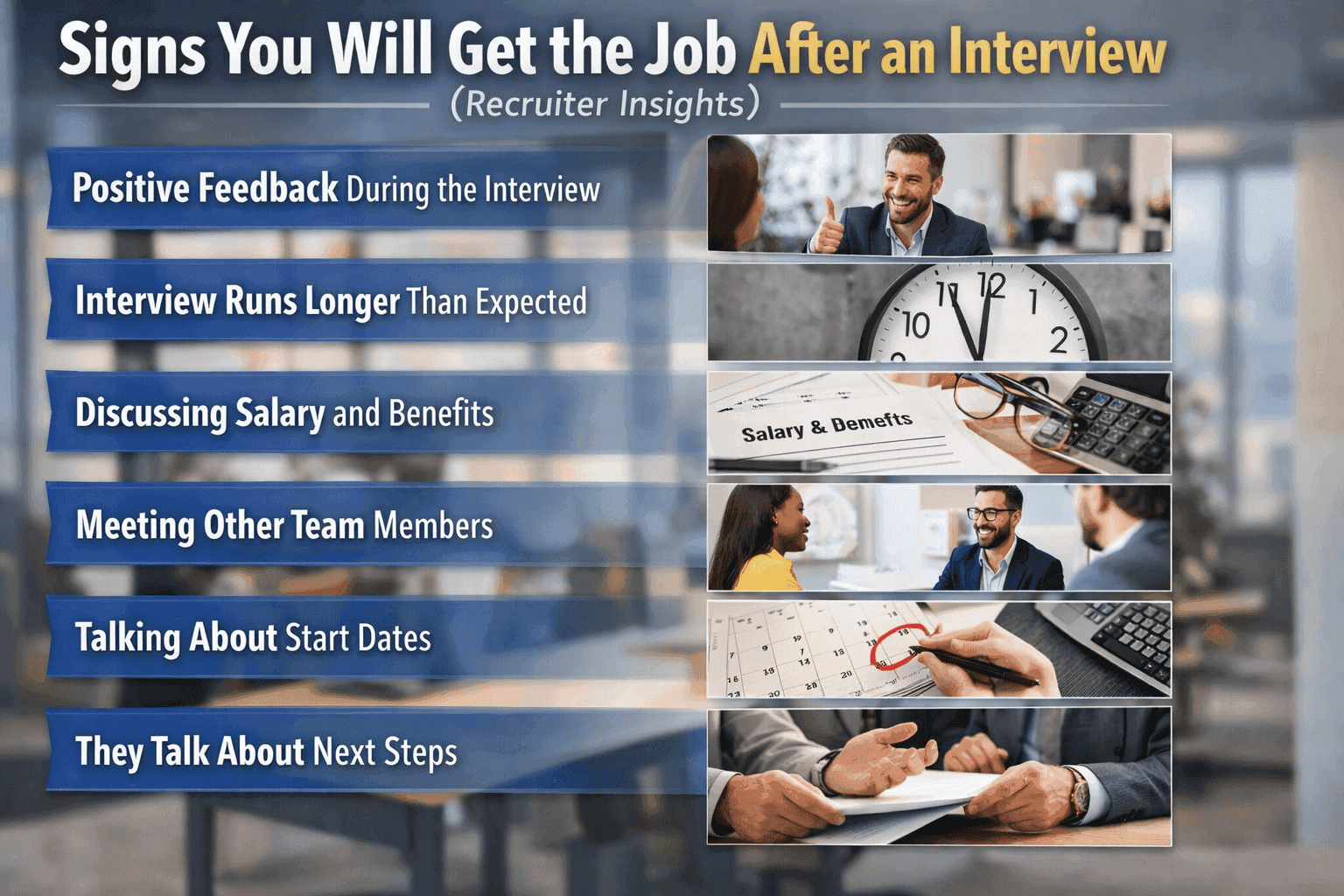
Signs You Will Get the Job After an Interview (Recruiter Insights)
Learn the most reliable signs you will get the job after an interview and how to understand recruiter signals.