Biodata vs Resume: Key Differences, Examples & When to Use Each
Understand biodata vs resume differences, uses, and examples to choose the right document for jobs, academics, or personal profiles.
Overview
Confused between biodata and resume? Discover key differences, real examples, and when to use each document for job applications, government roles, or academic purposes in 2026. Learn how to avoid common mistakes and improve your chances of success.
If you have ever sat down to apply for a job and wondered Is biodata and resume the same? You are not alone. The confusion is remarkably common, especially among first-time job seekers, students entering the workforce, and professionals switching careers across different countries. At a surface glance, both documents appear to serve the same purpose: they present information about you to someone evaluating your candidacy. But dig even slightly deeper, and the differences become impossible to ignore.
The short, definitive answer is: no, biodata and resume are not the same. They differ in purpose, content, tone, length, and the contexts in which they are expected. Confusing one for the other or worse, submitting the wrong document can seriously undermine your chances, whether you are applying for a corporate role, a government position, or even a matrimonial profile in certain cultures.
Key Points
- Biodata focuses on personal and biographical details
- Resume highlights skills, experience, and achievements
- Biodata is common in South Asia and government sectors
- Resume is globally accepted for professional jobs
- Resume is tailored for each job; biodata is usually generic
- Personal details like religion and family are in biodata, not resume
- CV is different from both and used in academic fields
- Using the wrong document can reduce hiring chances
- Resume is the safest option for corporate applications
- Always follow job posting requirements carefully
In this comprehensive guide, we will break down exactly what biodata and resume mean, how they differ, when to use each, how they compare to a CV, and what common mistakes you must avoid. By the end, you will have a crystal-clear understanding and the confidence to send the right document every single time.
"Submitting biodata where a resume is expected is one of the most common and most avoidable mistakes in the modern job search."
What Is Biodata? A Complete Definition
The word biodata is short for "biographical data." It is a document that records an individual's personal, family, and educational background in a structured format. Biodata originated in academic and government institutions, particularly in South Asian countries like India, Pakistan, and Bangladesh, and continues to be used in those settings today.
A biodata is primarily identity-focused. It answers the question: Who are you as a person? Rather than What can you professionally bring to this role? This distinction is critical. When you fill out a biodata, you are essentially presenting your life as a biographical record, not a professional pitch.
Also Read : How to Make a Resume for a Teacher Job | Step-by-Step Guide
What Does a Biodata Typically Include?
- Full legal name, date of birth, age, and gender
- Nationality, religion, and caste (in specific cultural contexts)
- Marital status and residential address
- Parents' names, occupations, and family background
- Educational qualifications listed in chronological order
- Hobbies, interests, and physical characteristics (sometimes)
- Languages known and extracurricular activities
Notice what is largely absent from this list: professional accomplishments, measurable achievements, key skills, or tailored career objectives. That is precisely what separates it from a resume. Biodata treats you as a person first and a professional second — or sometimes not as a professional at all.
Where Is Biodata Still Used?
Biodata remains relevant in government recruitment exams and clerical job applications in South Asia, matrimonial websites and marriage bureau profiles, school and college admission forms in certain regions, and entry-level applications at traditional or family-run organizations. Outside these contexts, biodata has very limited professional utility in the modern global job market.
Also Read : Indian Resume Format (Free Template + Pro Tips) | Resume Guide for Indian Job Seekers
What Is a Resume? The Professional Standard Explained
A resume derived from the French word meaning "summary" is a concise, targeted professional document designed specifically for job applications. Its sole purpose is to convince a hiring manager, recruiter, or HR professional that you are the right candidate for a specific role. Every line of a well-written resume earns its place by highlighting relevant skills, experience, or accomplishments.
Unlike biodata, a resume is not a biographical record of your entire life. It is a strategic marketing document. You would not include your father's occupation or your religion in a resume such details are irrelevant to a professional hiring decision and, in many countries, illegal to request during recruitment.
Core Components of a Strong Resume
- Professional summary or career objective (2–3 targeted sentences)
- Work experience with company names, job titles, dates, and bullet-pointed achievements
- Educational qualifications relevant to the role
- Technical and soft skills section
- Certifications, awards, or professional development
- Optional: Portfolio links, LinkedIn profile, or GitHub for technical roles
Types of Resumes
There are three primary resume formats used globally. The chronological resume lists your work history from most recent to oldest and is the most widely preferred format. The functional resume leads with skills rather than job history and suits career changers or those with employment gaps. The combination resume blends both approaches and works well for experienced professionals moving into a new field.
In today's competitive hiring landscape — especially in private companies, multinationals, and global organizations — a polished, role-tailored resume is the non-negotiable standard. This is why understanding that biodata and a resume are not the same is so practically important.
Also Read : Where to Put GPA on a Resume (Best Placement + Examples)
Key Differences Between Biodata and Resume
Now let us place these two documents side by side. The comparison below captures the most important distinctions between biodata and resume at a glance.
This table makes it visually clear why claiming biodata and resume are the same would be a significant error. The two documents inhabit completely different professional and cultural spaces.
Also Read : ATS-Friendly Marketing Resume Keywords With Examples
Real-World Examples: Biodata vs Resume Side by Side
The fastest way to truly internalize the difference between biodata and a resume is to see what each document actually looks like in practice. Consider the same individual let us call her Priya Mehta represented in both formats.
Sample Bio Data
- Name: Priya Mehta
- Date of Birth: 14 March 1997
- Gender: Female
- Marital Status: Unmarried
- Father: Mr. Suresh Mehta (Retired Teacher)
- Mother: Mrs. Anita Mehta (Homemaker)
- Religion: Hindu
- Education: B.Com, Mumbai University, 2019
- Languages: Hindi, English, Marathi
- Hobbies: Classical dance, reading
Sample Resume
- Name: Priya Mehta | priya@email.com
- Objective: Results-driven accountant seeking a Senior Finance Analyst role
- Experience: Finance Analyst, ABC Corp (2019–2024)
- Achievement: Reduced monthly reporting time by 40%
- Skills: Excel, Tally, SAP, financial modelling
- Education: B.Com (Distinction), Mumbai University
- Certification: CFA Level I (2022)
- LinkedIn: linkedin.com/in/priyamehta
The contrast is stark. Priya's biodata tells a recruiter her family background and hobbies. Her resume tells them she can cut reporting time in half and holds professional certifications. For a corporate hiring manager, only one of these documents is useful — and it is not the biodata.
Also Read : How Long Is a CV? Ideal Length by Career Stage, Industry & Country
Biodata vs CV vs Resume: What Is the Difference?
Job seekers frequently encounter a third term that adds to the confusion: the CV, or Curriculum Vitae. To fully answer whether biodata and resume are the same, it helps to understand where the CV fits in as well.
Curriculum Vitae (CV)
A CV is a comprehensive academic and professional record. Unlike a resume, a CV does not aim to be brief. It includes your complete educational history, all work experience, research publications, conference presentations, teaching experience, grants, and awards. CVs are primarily used in academia, research institutions, medicine, and higher education. A CV for a senior academic can run ten pages or more.
How All Three Compare
Think of it on a spectrum. Biodata sits at one end, focused on personal identity. The resume occupies the professional middle ground — concise, targeted, and career-focused. The CV sits at the other end, offering exhaustive professional and academic detail. All three are entirely different documents used for entirely different purposes.
Quick Rule of Thumb
- Applying for a corporate or private-sector job? → Use a Resume
- Applying for academic research, a university position, or a grant? → Use a CV (Curriculum Vitae)
- Filling out a government form or creating a matrimonial profile? → Use a Biodata
Also Read : How to Make a Student Resume (Complete 2026 Guide)
When to Use Biodata and When to Use a Resume
Knowing which document to submit is as important as knowing how to write one. Sending the wrong document signals either inexperience or a lack of attention to detail — neither of which impresses a recruiter.
Use Biodata When:
- The job posting or institution explicitly requests a "biodata" by name
- Applying for certain government clerical, teaching, or administrative positions in South Asia
- Creating a matrimonial or family introduction profile
- Filling out enrollment or admission forms for educational institutions
- Applying through traditional family-run businesses that follow older hiring customs
Use a Resume When:
- Applying for any private-sector, startup, or corporate job role
- Sending applications to multinational companies or global organizations
- Seeking internships, freelance work, or consulting engagements
- Submitting to job portals like LinkedIn, Indeed, or Naukri
- Networking professionally and sharing credentials with potential employers
- Applying for jobs in any country outside South Asia, where biodata is not customary
The golden rule: when in doubt, default to a resume. In today's globalized job market, a well-crafted resume is almost universally appropriate for professional applications. Biodata, by contrast, has very narrow and specific use cases.
Also Read : HR Executive Resume Guide With Format, Skills, and Examples
Common Mistakes to Avoid
Understanding that biodata and a resume are not the same is only half the battle. Many candidates still make easily avoidable errors that hurt their applications. Here are the most critical ones to watch out for.
Submitting Biodata for a Professional Job
This is the single most common mistake. A hiring manager at a technology company, marketing agency, or bank does not need to know your father's occupation or your religion. Submitting a biodata in this context appears unprofessional and out of touch with modern hiring norms. Always send a resume for professional applications unless explicitly told otherwise.
Adding Personal Details to a Resume
The reverse mistake is equally harmful. Adding marital status, date of birth, parents' names, or a passport-sized photo to a resume is considered inappropriate in most Western and global corporate contexts. In countries like the United States, the United Kingdom, Canada, and Australia, such details can actually lead to unconscious bias claims and are strongly discouraged. Keep your resume strictly professional.
Using a One-Size-Fits-All Document
A resume should never be a static, generic document. Unlike biodata — which is typically uniform — a resume must be tailored for every role you apply for. Customize your career objective, highlight the most relevant experience, and mirror keywords from the job description. Generic, untailored resumes routinely fail to pass Applicant Tracking Systems (ATS) before a human ever sees them.
Ignoring the Employer's Stated Requirements
Always read the job posting carefully. Some traditional institutions and certain government bodies explicitly request biodata. Submitting a resume when biodata is requested — or vice versa — shows poor attention to detail and will likely disqualify your application immediately.
Also Read : How to List Publications on a Resume (Examples & Format Guide)
Conclusion
So, are biodata and resume the same? Absolutely not. Despite sharing a few common elements — like your name and educational background — these two documents are fundamentally different in purpose, content, tone, and application. Biodata is a personal, biographical record rooted in traditional and cultural contexts. A resume is a modern, strategic, professional tool engineered to win you job interviews.
In the global job market of 2025 and beyond, resumes dominate. They are universally understood, expected by employers across industries, and — when well-crafted — are your most powerful career asset. Biodata, while still relevant in specific cultural and government contexts, is a niche document with limited professional reach.
The key takeaway is simple: always match your document to the context. When applying professionally, invest the time to create a polished, tailored resume. Reserve biodata for the contexts where it is explicitly requested. Understanding this distinction is not just academic — it could be the difference between landing an interview and having your application quietly ignored.
Start today: Review your current resume, make sure it is free of unnecessary personal details, and tailor it specifically for the next role you want to pursue. Your professional document deserves to be as strong as your ambitions.
FAQs
Frequently asked questions about this topic
Related Blogs
Explore more insights and guides you might like.
How to List References on a Resume in 2026
Learn the modern 2026 approach to listing references on your resume for maximum professionalism and recruiter impact.

Is Sound CV good for students and fresh graduates with no experience?
Sound CV is perfect for students and fresh graduates, helping them create professional resumes that highlight skills, projects, and potential even with little or no work experience.
Why Sound CV Is Different from Other AI Resume Builders
Sound CV stands out by creating job-focused, ATS-friendly resumes that highlight real achievements, not just generic content.
Resume Format for HR Job: Professional Guide and Sample Templates
A complete guide to the best resume format for HR jobs, with expert tips and sample templates to help you create a professional and job-ready resume.
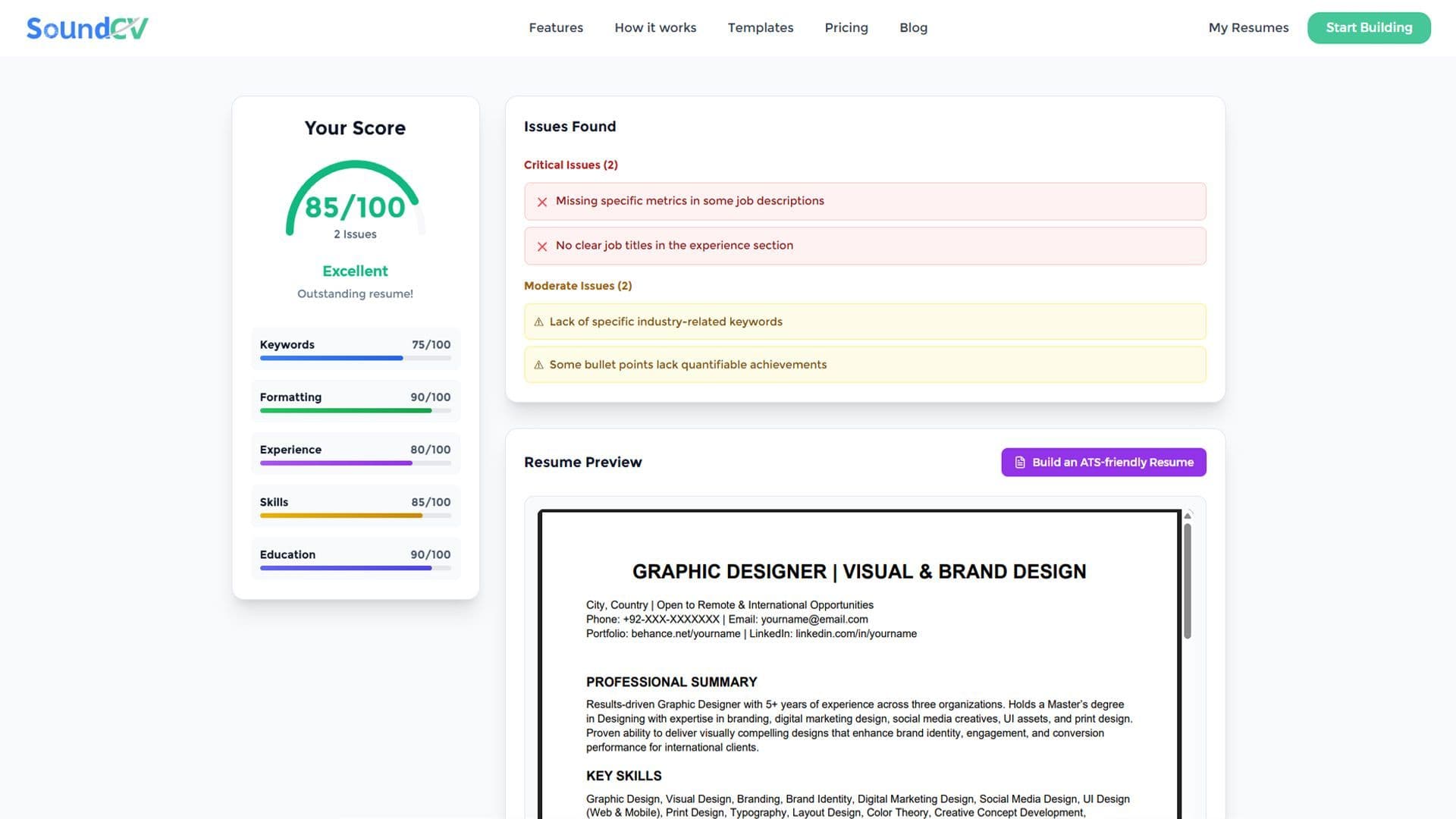
How Does the Sound CV Resume Score Checker Work?
The Sound CV Resume Score Checker analyzes your resume against ATS requirements, job-specific keywords, and structure to provide an instant, actionable score.
What Is a Sound CV? Features, Benefits, and How It Works
A Sound CV is an AI-powered resume that is tailored, ATS-optimized, and designed to showcase your skills and achievements to help you stand out to recruiters.